

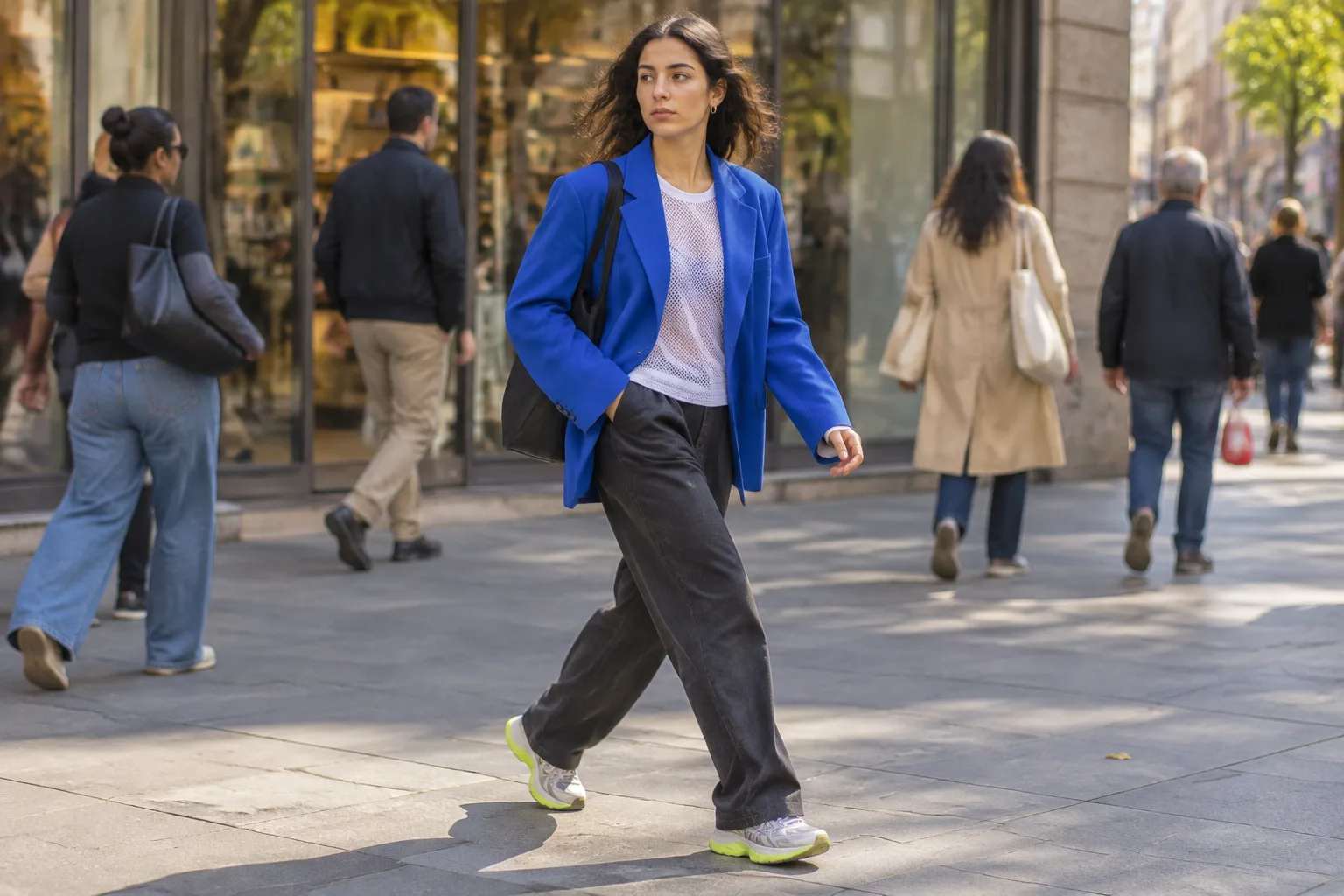
Athleisure, Every Day: Turning Sport Into Street
The gym floor used to be a border. Beyond it, in the locker room, a person shed the synthetic jersey, the mesh shorts, the shoes built for lateral cuts, and stepped back into denim and leather and whatever the day demanded. Athleisure erased that border, then paved over it. The same leggings that survive a spin class now sit under a blazer in a conference room. The running shoe with the carbon plate shows up at brunch. Sport leaked into the street and then flooded it, and the result is a wardrobe that treats every sidewalk like a training surface and every day like a recovery day.
The look is everywhere because it solved a real problem. People wanted clothes that moved, and the old street uniform did not move. Denim has no give at the hip. Dress shoes punish a long walk to the train. The athleisure wardrobe answered with four-way stretch, moisture-wicking knits, and soles with actual cushioning, and once a person felt that ease against the skin, going back to a stiff waistband felt like a small daily punishment. Comfort won. It usually does.
The compression tight became the new pair of jeans
Watch a commuter at 8 a.m. on a Tuesday. The leggings are matte black, high-waisted, cut with a seam that traces the hip. The top is a cropped sweatshirt or an oversized zip fleece. The shoes are white, chunky, and clean enough to suggest they were chosen, not grabbed. Nothing about this outfit belongs to a gym. The person is going to an office, or a coffee shop that serves as an office, and the clothing has been tuned to look intentional rather than athletic.
That tuning is the whole trick. The early athleisure of the 2010s announced itself: neon panels, visible branding across the chest, running tights with reflective piping. The current version hides its origins. A good pair of street leggings has the pocket structure of trousers and the compression of sportswear, and it reads as neither. The fabric does the work silently. Elastane blends hold their shape through a full day of sitting and standing, and a flat lock seam does not dig into the waist after lunch.
The jeans comparison is not loose. Denim ruled the casual wardrobe for a century because it was durable, universal, and forgiving of a bad day. Leggings took that throne in part because they are more forgiving still. They accommodate a body that changes size, a body that is pregnant, a body recovering from surgery. A single garment absorbs a range of lives that denim could only approximate through a dozen cuts and washes.
Why the running shoe moved from the trail to the sidewalk
The footwear tells the same story more loudly. A cushioned trainer with a thick foam midsole and a knit upper was engineered for heel strikes and long miles. On the street, it became a statement about pace of life. The wearer is not running anywhere, and that is the point. The shoe says the day is long and the feet matter more than the dress code. A leather loafer would look sharper in a photograph and leave the ankles aching by four in the afternoon.
There is a practical arithmetic underneath the aesthetics. A person who walks fifteen thousand steps across a city does not need a shoe built for a boardroom. The chunky sole absorbs pavement, the rocker geometry rolls the foot forward, the breathable upper keeps a sock dry in summer. These are engineering choices borrowed from distance running and applied to a commute, and they work. When a shoe company releases a lifestyle colorway of a performance model, it is admitting that most of its customers will never race in it.
The hoodie as a blazer substitute and the limits of that swap
Layering is where athleisure gets ambitious and where it sometimes trips. A structured hoodie in a heavy loopback cotton can pass in an office that has relaxed its dress code, especially in a dark color with clean stitching. A zip-through fleece over a collared shirt reads as deliberate. The wearer is signaling effort, just not the old kind. The old kind involved starch and a crease. The new kind involves matching a warm neutral to a sneaker and keeping the whole thing wrinkle-free.
The limit shows up in a formal room. A board meeting with clients in suits, a wedding, a courtroom, a funeral: athleisure cannot carry those rooms, and pretending otherwise makes the wearer look careless rather than comfortable. The fabric is honest about its purpose. A performance knit drapes softly and catches light the way a wool jacket never will. There is a ceiling here, and the people who style this look best know exactly where it sits. They wear the stretch on the commute and the jacket in the room.
The price of looking like nothing was decided
The look reads as effortless, and that effortlessness is expensive. A single pair of high-end leggings can cost more than a decent pair of dress trousers. The technical fabrics justify some of it: the mills that produce a matte, squat-proof knit with good recovery charge accordingly, and the seams and paneling add labor. But a large share of the price tag is the brand, and the brand is selling a lifestyle where the wearer has time for a class, a walk, and a coffee, all in one outfit.
There is also a quiet sorting happening. The person in a well-cut, unbranded set of technical clothing looks like she has options. The person in the discount version, with a shiny fabric and a sagging waistband, looks like she is stretching a gym membership across a workweek. Same category, different signals. Athleisure promised to democratize comfort and instead built a new ladder, with the rungs set by fabric quality and the absence of a logo.
The office never fully agreed to this
Corporate dress codes have bent, not broken. Plenty of workplaces now permit a clean sneaker and a knit top while still drawing a line at leggings, especially in client-facing roles. The compromise tends to settle on "smart casual," a phrase that means the clothes must look considered. A jogger in a crepe fabric with a pressed seam passes. A jogger in a cotton sweatpant does not. The distinction lives in the details, and the details are where most people get caught out.
This is why the athleisure wardrobe rewards a little discipline. The people who wear it well tend to own fewer pieces and keep them in better condition. A stretched-out waistband, a pilled thigh, a yellowed white sneaker: these read as neglect, and neglect is the one thing the look cannot absorb. The whole premise is that the clothing is easy, and easy clothing that looks tired undermines the premise.
The textile problem nobody photographs
Most athleisure is plastic. Polyester, nylon, elastane: these fibers are cheap, strong, and good at wicking, and they dominate the category for those reasons. They are also shed in the wash. Every cycle releases tiny fibers into the water supply, and those fibers do not biodegrade on any human timescale. A wardrobe built on synthetic stretch is, at the scale of a city, a slow and steady contribution to a problem the wearer never sees.
Natural-fiber alternatives exist, and they cost more and perform differently. Merino blends regulate temperature well and resist odor, which matters for a garment worn between workouts and meetings. Tencel and modal drape softly and come from wood pulp. None of them match the recovery of a high-elastane knit, and that recovery is exactly why the look took over. The comfort that made athleisure universal is, in large part, the comfort of oil-derived fiber.
What the outfit says about the day it is built for
Strip away the branding and the styling and a simpler message remains. The athleisure outfit is designed for a day with no fixed shape. It works for a morning walk, a desk, a school pickup, a grocery run, a late train. It assumes the wearer will move between contexts without a changing room, and it refuses to make any single context the priority. That refusal is the real innovation. The old wardrobe forced a choice at the closet door: dress for the meeting or dress for the walk. The new one declines the choice.
So the person on the platform in black leggings and white trainers is not dressed for sport. She is dressed for a day that will not hold still, and she has decided that her feet and her waist and her ability to sit on the floor of a waiting room matter more than the crease in a trouser. The outfit is a bet that the day will be long and varied, and that comfort is a form of readiness. Most mornings, that bet pays.
By evening the same clothes have been through a full day, and they still look nearly the same as they did at breakfast. That is the quiet test the category keeps passing. A wool suit needs a brush and a hanger and a day of rest. The stretch set needs nothing. It goes back on tomorrow, and the border between the gym and the street stays paved over for another day.