

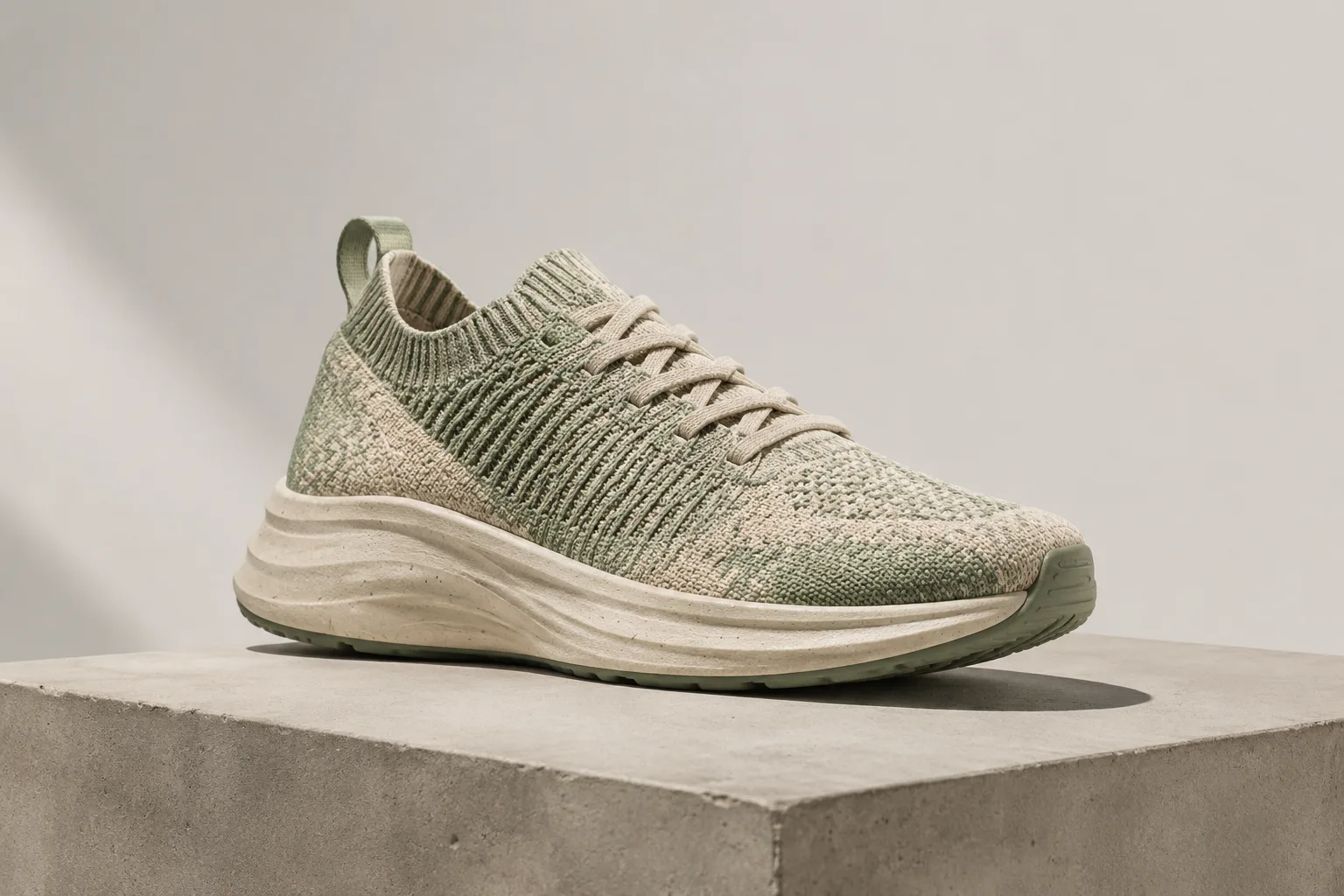
Considered Kicks: Sustainable Sneakers Worth a Second Look
Sustainable sneakers have a public relations problem, and it is visible from across the room. The category conjures a specific image: undyed hemp, a sole that looks like a rice cake, laces the color of oatmeal, and a price that assumes the buyer already owns a tote made from recycled sailcloth. The shoe signals virtue loudly enough that wearing it feels like a statement, and not always a flattering one.
This is a shame, because the actual engineering happening in the space has gotten genuinely interesting. A handful of brands have moved past the marketing gesture and into the materials lab, and the results look like shoes a person might wear on purpose, to a place other than a farmers market.
The interesting work is not happening where the loudest claims are. It is happening in the unglamorous middle: midsoles, adhesives, dye baths, and the quiet chemistry of turning waste streams into something that flexes under a foot for 500 miles.
What "sustainable" actually covers in a sneaker
A sneaker is a small industrial puzzle. Most pairs combine a dozen or more materials, each with its own supply chain, and glue them into a shape that has to survive pavement, rain, and the repeated folding of a human stride. The upper, the midsole, the outsole, the lining, the laces, the eyelets, the adhesive: every one is a separate decision.
Most claims address one slice of that puzzle. A shoe made from recycled plastic bottles says something about the upper and nothing about the sole, which is often the part that determines whether the thing ends up in a landfill. A "vegan" label describes the absence of leather, not the presence of a durable alternative. The word sustainable, applied to footwear, is doing roughly the work of the word natural on a cereal box.
The brands worth attention tend to be specific. They name the material, the supplier, the percentage, the end-of-life plan. Vagueness in a product page is a tell, the same way it is on a restaurant menu.
The sole is where the argument gets settled
Midsoles are traditionally made from EVA foam, a petroleum product that performs beautifully and biodegrades on a geological timescale. The most credible experiments in the category replace it with something that behaves similarly underfoot but breaks down differently in the ground.
Several brands now use foams derived from sugarcane or castor beans. The feel is close to conventional EVA: a little firmer at first, slightly more temperature-sensitive in cold weather, breaking in over a week or two. The trade-off is real but small. A wearer notices it on the first long walk and then stops noticing.
The more interesting development is in outsoles. Natural rubber, tapped from trees rather than synthesized, has returned to a few serious models. It grips well on wet pavement, wears a touch faster than the synthetic stuff, and carries a smell that is faintly, pleasantly vegetal when the box first opens.
Recycled uppers and the texture question
Knitted uppers made from recycled polyester have become the default move, and the results vary wildly. The cheap version has a slick, slightly plastic hand and a sheen that catches light in a way that reads as athletic rather than refined. The good version feels like a dense sock, with a matte surface and enough structure to hold a shape.
Color is the quiet problem. Recycled yarns are harder to dye consistently, so early runs of these shoes tended toward heather grays and muted olives, colors forgiving of variation. That is changing. A few brands now offer deep navy, oxblood, and a black that holds up in daylight.
Leather alternatives have improved more than the marketing suggests. Mushroom-derived mycelium and plant-based leathers have moved from novelty to viable, with a grain that reads as leather at arm's length and a break-in period that is shorter than traditional hides. They still crease differently, and a careful eye can spot the difference across a room. Most people are not looking that carefully.
The adhesive nobody photographs
Here is the unglamorous truth about shoe construction: the glue holds the whole thing together, and conventional adhesives are stubbornly petroleum-based. They are also the reason many "recyclable" shoes are not, since a shoe bonded with permanent adhesive cannot be easily separated into its component parts.
A few forward-leaning brands have moved to water-based adhesives or to construction methods that stitch or heat-bond instead of glue. These are not photogenic innovations. They do not appear in the hero image. They matter more than most of what does, because a shoe that can be disassembled is a shoe that can be remade.
Take-back programs deserve a skeptical look for the same reason. A brand that accepts worn pairs for recycling is only as good as its actual disassembly line. Some are real. Some are a shipping label and a press release.
A short, opinionated list of pairs that hold up
The strongest all-rounder in the category right now is the Veja Campo, a shoe that has become common enough to lose some of its novelty but has earned its place. Chrome-free leather, a wild rubber sole, a clean silhouette that works with denim and wool trousers alike. It is not the most radical shoe on this list. It may be the most wearable.
For something closer to a running silhouette, the Allbirds Tree Dasher trades the brand's early wool upper for a eucalyptus-based knit and a sugarcane midsole. The result is breathable, light, and slightly springy underfoot, with a fit that runs narrow. The outsole wears faster than a dedicated trainer, so it is better suited to city miles than to a marathon block.
On Running's Cyclon is the most ambitious experiment in the space, sold on a subscription model with a full take-back and remake loop. The shoe itself is a serious piece of engineering, with a castor bean-derived midsole and a upper made from recycled materials. The subscription structure is not for everyone, and the colorways are limited by design. The concept, though, is the closest thing to a closed loop currently on the market.
For a lower price point, Adidas's Parley line, made in part from intercepted ocean plastic, remains a reasonable entry. The uppers are recycled, the soles are conventional, and the shoe is honest about being a partial solution rather than a total one.
Durability is the most sustainable feature
The most important variable in a shoe's environmental footprint is not its materials. It is how long the wearer keeps it. A conventional sneaker worn for five years beats a compostable one worn for eight months, every time. The math is not close.
This is where the sustainable category has historically struggled. Early models prioritized story over structure, and a shoe that falls apart in a season is a worse environmental choice than a sturdy one made from virgin materials. The good news is that the current generation has closed much of that gap. A well-made pair from a serious brand now lasts roughly as long as its conventional equivalent.
The maintenance habits matter more than the label. A cedar shoe tree, a rotation of two pairs, an occasional wipe with a damp cloth, a resoled sole where the construction allows it. These are the moves that turn a three-year shoe into a six-year one.
The resale and repair layer forming underneath
A quiet infrastructure is growing around these shoes. Repair services that will resole a sneaker for a fraction of its purchase price, resale platforms that specialize in worn pairs, and cobblers who have learned to work with the newer materials. This is the part of the category that does not appear in brand campaigns and probably matters most.
A sneaker that can be repaired is a sneaker that can be owned for a decade. The brands designing for disassembly are, whether they say so or not, designing for this future. The ones gluing their soles on with permanent adhesive are designing for the bin.
The next time a pair of these shoes shows up in a closet, the test is not the label on the box. It is whether the shoe is still being worn in year four, and whether anyone can fix it when the sole goes thin.