

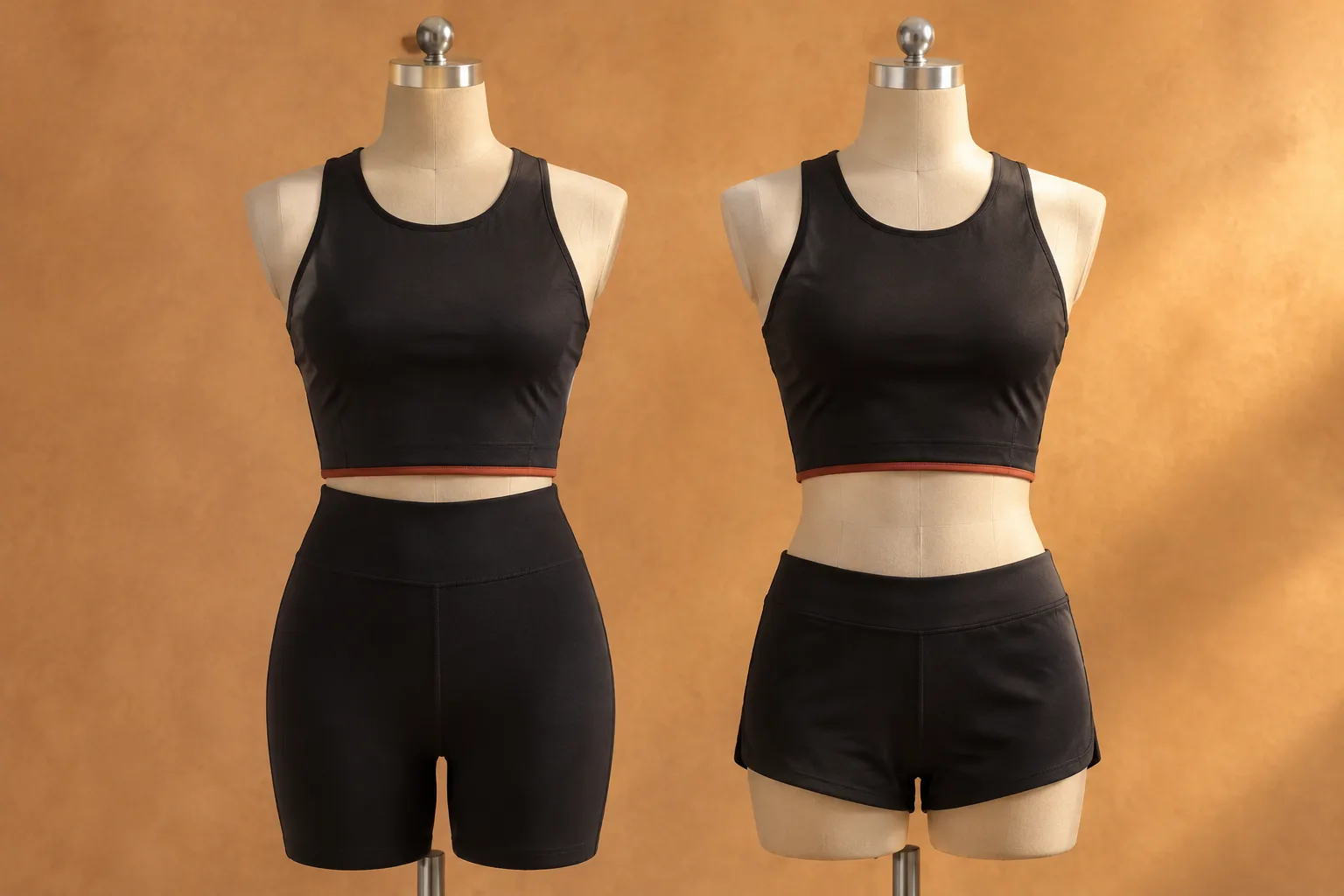
Cropped or Covered: Finding Your Activewear Silhouette
The two most common silhouettes in activewear catalogs are the cropped top and the high-coverage one, and the distance between them is usually described as a matter of modesty. That framing is lazy. The real variable is the waistband, and once the waistband enters the conversation, the choice becomes structural. A crop that ends an inch above a low-rise short and a crop that ends an inch above a high-rise tight are not the same garment in practice, even when the measurements on the tag are identical.
Most activewear shoppers learn this the expensive way, buying a top and a bottom in separate orders, then discovering at the gym that the two pieces were designed for different bodies or different eras. The fix is to stop treating "cropped" and "covered" as personalities and start treating them as coordinates on a single grid: where the hem lands, where the waistband sits, and how much skin shows at the intersection.
That intersection is the whole game. Everything else is marketing.
What the Hem-to-Waistband Gap Actually Measures
Picture three tops with hems that fall at the natural waist, at the bottom rib, and just under the bust. Now picture three bottoms: a high rise that reaches the navel, a mid rise that sits two fingers below it, and a low rise that perches on the hip bones. Nine combinations, and only some of them are comfortable, flattering, or stable during a workout.
The high-rise tight with a hem landing at the natural waist produces a clean overlap: a strip of fabric covering the waistband, no skin, no gap. Slide the same top up to the bottom rib and a two-finger band of midriff appears. Slide it to the underbust and the top becomes a sports bra in all but name. The high rise is doing most of the work of coverage in every one of those configurations. A low rise flips the math entirely. The same underbust crop over a low-rise short shows a long, continuous stretch of torso, and the wearer is now committed to a look that reads as deliberate only if the bottom is cut correctly.
This is why fit guides that ask "crop or cover?" without asking "over which waistband?" are close to useless. The garments are co-dependent.
The Crop That Reads as Coverage
A cropped top over a high-rise bottom is, functionally, a covered outfit. The skin gap closes. The visual line runs unbroken from shoulder to hip. Runners who prefer this setup tend to like it for reasons that have nothing to do with modesty: the high waistband holds the top steady, there is no fabric bunching at the hip crease, and the whole assembly behaves like a unit rather than two independent pieces sliding in opposite directions.
Yoga and pilates practitioners often land here too, though for a different reason. Inversions and deep folds expose the back and shoulders, and a slightly longer crop that overlaps a high waistband keeps the top from riding up over the head during a forward fold. The coverage is real; it is just distributed differently than a full-length tank would distribute it.
There is a catch, and it concerns proportion. A crop that ends at the natural waist over a high rise that reaches the navel creates a short torso visually, because the eye reads the high waistband as the start of the legs. On a long-waisted frame, that is a gift. On a short-waisted frame, it can make the upper body look compressed. The fix is not to abandon the combination but to move the hem: a crop that ends just below the bottom rib lengthens the visible midsection by an inch or two.
Where the Full-Length Top Earns Its Keep
The full-coverage top has a reputation problem in some corners of activewear culture, where it is assumed to signal a lack of confidence. That reading is mostly nonsense. A long, fitted top over a mid- or high-rise bottom is the most reliable silhouette for cycling, rowing, and any activity where the torso folds forward repeatedly. Nothing rides up. Nothing needs adjusting mid-stroke.
It also solves a problem crops cannot solve at all: layering. A full-length tank under a loose short-sleeve or a light jacket behaves the way a base layer is supposed to behave. A crop under the same jacket creates a cold gap at the waist that becomes noticeable on a walk or a cool-weather run. The covered silhouette is the one that accommodates weather.
The risk with full coverage is a different sort of proportion issue. A long top over a low-rise bottom hides the waistband entirely and can make the legs look shorter than they are, because the eye has no horizontal reference at the hip. Over a high rise, the same top creates a single long line from shoulder to thigh. The high waistband does the structuring work that the top itself cannot.
Fabric Weight Changes the Equation Mid-Workout
Silhouette in a dressing-room mirror is static. Silhouette at minute forty of a sweaty session is not. A light, thin crop has a tendency to migrate upward during overhead movement, and a crop that started just below the rib can end up under the arms after a set of jumping jacks. Heavier knit crops hold their position better, though they feel warmer.
The same logic runs through the bottom. A thin, high-stretch waistband on a high-rise tight can roll down during a sustained forward fold, quietly converting a covered silhouette into something closer to the low-rise look the wearer was trying to avoid. A wide, firm waistband holds. This is why the waistband construction matters as much as the rise measurement printed on the tag.
A simple test in the fitting room, if one is available: raise both arms overhead, then bend forward and touch the floor. A crop that stays put through both is a crop that will behave in class. A high waistband that does not fold over on the forward bend is a waistband worth paying for.
The Mid-Rise Middle Ground and Why It Gets Skipped
Mid-rise bottoms occupy an awkward position in the current market, largely because high rise has absorbed so much of the conversation. A mid rise that sits an inch or two below the navel pairs with a slightly longer crop to produce a small, deliberate strip of skin at the side, and a clean line at the front. It is a more forgiving combination than either extreme for a lot of body types, particularly for wearers who find high rise uncomfortable across the stomach or low rise unstable at the hip.
The reason it gets skipped is that it requires more precision. A high rise forgives a slightly long crop. A low rise forgives a very short one. A mid rise punishes a hem that lands in the wrong place by an inch, and an inch is exactly the increment most shoppers cannot assess without trying the two pieces together. The middle ground rewards measurement and punishes guesswork.
Torso Length Is the Variable Nobody Prints on the Label
Two people can wear the same crop and the same high-rise tight and end up with completely different silhouettes, because torso length varies more than most sizing charts admit. A crop that covers the waistband on a shorter torso may sit an inch above it on a longer one. This is not a fit failure; it is arithmetic.
The practical consequence: the wearer's own torso length, measured roughly from the shoulder to the natural waist, should determine which hem heights get considered at all. A longer torso generally tolerates a slightly longer crop and a higher rise without looking compressed. A shorter torso does better with a crop that ends just below the rib and a rise that stops at or just under the navel, leaving visible midriff to break up the line.
Most activewear brands do not publish torso-length guidance, which means the wearer has to do the math. Measure once, note the number, and then read hem and rise measurements against it rather than against a model photo shot on someone with a different frame.
Layering a Crop Over a Covered Base
There is a third silhouette that gets almost no catalog space: the crop worn over a full-length base. A fitted long-sleeve under a looser crop tank produces coverage at the waist and a defined shape at the shoulder, and it handles temperature swings better than either piece alone. The crop becomes a styling layer rather than a coverage decision.
This combination is popular in studio settings where the room is cool at the start of class and warm twenty minutes in. The long-sleeve comes off, the crop stays, and the silhouette shifts without requiring a change of outfit. It also solves the migration problem: the base layer anchors the waistband, and the crop can move a little without exposing anything.
The only rule is that the base layer should be fitted enough to stay tucked and thin enough not to bunch under the crop. A loose base under a fitted crop reads as a mistake. A fitted base under a loose crop reads as intent.
A Pairing Rule That Survives Contact With a Real Workout
The rule that holds up across most bodies and most activities is this: let the bottom set the coverage, and let the top follow. Choose the rise first, based on what stays put during the specific movement the wearer does most. Then choose the hem so that it either overlaps the waistband by an inch or clears it by an inch, deliberately, with nothing in between. The half-inch gap, the one that appears by accident, is the one that looks like a fit error rather than a choice.
That single rule eliminates most of the dressing-room confusion. The crop and the covered top stop being identities and become tools that serve whatever the waistband is already doing. A high rise invites a crop. A low rise demands a longer top or a very short one, chosen on purpose. A mid rise asks for precision and rewards it.
The wearer who knows the number, hem to waistband, stops shopping by vibe and starts shopping by measurement. The outfit stops being a gamble and becomes a decision.