
Fabric First: Activewear That Keeps Its Lines After a Wash
Cotton jersey sags. That is the first fact of laundry, and every person who has pulled a limp, knee-bagged pair of leggings from a dryer knows it in the wrists and the mirror. Activewear is supposed to solve this. The label promises compression, recovery, a silhouette that holds. Then the first warm wash happens, and the garment comes out with a different personality: softer, looser, faintly apologetic.
The fabrics that survive that wash are not magic. They are engineered, and the engineering is legible once a person knows what to look for. The difference between a pair of tights that keeps its lines through fifty cycles and one that gives up around wash four comes down to fiber, knit structure, and how the seams are built. All three are visible on a tag and in a hand.
This is a piece about reading those signals before purchase, and about the laundering habits that decide whether a good garment stays good.
The fiber that does the holding
Elastane, sold under names like Lycra and spandex, is the elastic component in nearly all stretch activewear. It is what allows a fabric to return to shape after being stretched across a hip or a shoulder. The problem is that elastane is fragile in ways cotton is not. Heat degrades it. Chlorine attacks it. Repeated tumbling breaks the fine filaments down, and once they go, the garment stops snapping back.
Most performance knits pair elastane with a synthetic partner: polyester or nylon. Polyester is cheap, holds color, and resists wrinkles. Nylon is stronger and smoother against skin, with better recovery at the same weight. Neither fiber absorbs much water, which is why activewear dries fast and why it also holds odor if it is not washed properly.
The proportion matters. A legging with 12 percent elastane will feel firmer and recover better than one with 5 percent, though it may also feel tighter and less breathable. A higher elastane content is not automatically superior; it is a tradeoff between hold and comfort. What matters for line retention is that the elastane is present in a meaningful amount and that the knit is dense enough to keep the fibers from sliding past one another.
Why a dense knit outlasts a soft one
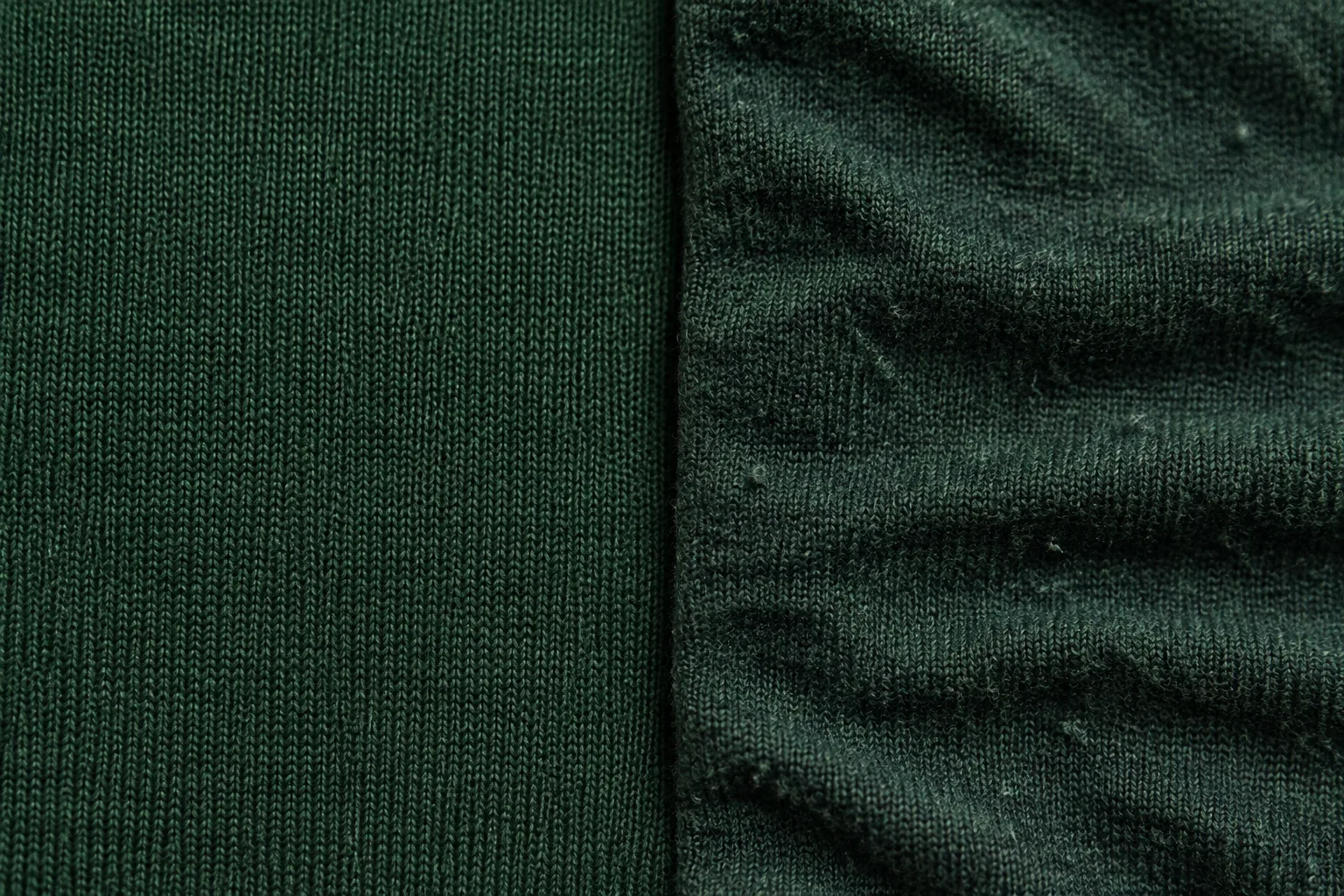
Two leggings can carry identical fiber percentages and behave completely differently after ten washes. The variable is knit density: how tightly the loops are packed and how much tension the fabric carries off the bolt.
A loose, lofty knit feels wonderful in the fitting room. It drapes, it breathes, it hides nothing. It also has more room for fibers to migrate. Under repeated stretching and washing, the loops relax, the fabric grows, and the garment develops the dreaded bag at the knee and the seat.
A denser knit, often described on tags as "interlock" or "double-knit," packs more yarn into the same square inch. It feels slightly firmer and less immediately plush. It also holds its geometry. The loops cannot shift as far because there is less empty space to shift into. This is the single most reliable predictor of whether a garment will keep its lines, and it is testable in the store: stretch a section of fabric between two hands and release it. A dense knit snaps back with a small, satisfying recoil. A loose one returns slowly and slightly larger.
The seam problem nobody mentions
Fabric gets all the attention. Seams decide whether the garment looks intact after a year.
Flatlock seams, the interlocking stitch used on most quality activewear, join two fabric edges without a raised ridge. They stretch with the fabric and distribute tension along the stitch line. A well-executed flatlock survives hundreds of cycles. A poorly executed one, with uneven tension or a skipped stitch, becomes the failure point: the seam puckers, the thread abrades, and a small hole opens at the crotch or underarm, usually within a season.
Bonded seams, glued rather than stitched, offer an even cleaner line and no thread to break. They are also less forgiving of heat. A bonded seam that survives cold washes can delaminate in a warm dryer, and once the bond fails, the garment is finished. Bonded construction is a legitimate choice for a race-day piece; it is a gamble for something washed weekly.
What the care label is actually protecting
Most activewear tags read "machine wash cold, tumble dry low." Nearly everyone ignores the second half. The dryer is where line retention goes to die.
Heat does two things to elastane. It relaxes the molecular structure so the fiber loses some of its ability to return, and it accelerates the breakdown of any bonding adhesive. A single high-heat cycle will not destroy a good pair of tights. Fifty of them will. The cumulative effect is a garment that still fits but no longer compresses, that has gone soft and slightly shapeless in exactly the places that matter.
Cold water is gentler on the fibers and on the dyes. A mesh laundry bag protects against snags and reduces the mechanical agitation that abrades seams. Turning garments inside out keeps the face fabric from pilling against zippers and hooks. None of this is exotic; it is the difference between treating activewear as performance gear and treating it as a t-shirt.
Fabric softener deserves a specific warning. The coating that makes towels fluffy deposits on synthetic fibers and reduces their ability to wick moisture, and it can leave a film that traps odor. A person who uses softener on activewear is quietly degrading the two properties they paid for.
The wash-cycle test that separates two similar pairs
A useful exercise for anyone building a wardrobe: buy two pairs of leggings at different price points, wash both five times in cold water, and hang them side by side. The cheaper pair will typically show visible relaxation at the knee and hip, a slight sheen from fiber abrasion, and a seam line that has begun to wave. The better pair will look nearly new.
The comparison is not about price. It is about construction, and construction correlates with price only loosely. There are inexpensive dense knits with solid flatlock seams, and there are expensive garments with bonded seams that fail in the first warm wash. The test costs one laundry cycle and settles the question in a way no product description can.
Where compression fit and line retention diverge
A common assumption holds that tighter activewear holds its shape better. The fitting-room logic runs that a garment stretched to its limit will spring back to the same limit after washing. In practice, a garment worn at the edge of its stretch capacity fatigues faster. The elastane is under constant tension, and constant tension is exactly what wears it out.
The better fit leaves a little room. A legging that compresses without strain, that does not require a fight to pull on, will outlast one sized down for a firmer feel. This runs against the instinct to buy the smallest size that closes, and it is worth stating plainly: the garment that keeps its lines is usually the one that was not overstretched to begin with.
The laundering habits that buy years
Wash less often. Activewear worn for a single low-sweat session can usually air out and be worn again; the fibers do not need soap after every commute. Wash in cold water with a small amount of gentle detergent, no softener, and skip the dryer entirely. Hang or lay flat to dry, away from direct heat.
These habits cost nothing and extend the useful life of a garment by years. A pair of well-built tights treated this way will still hold its lines long after a cheap pair has been retired to gardening duty. The fabric was always going to be the deciding factor, but the care routine decides how much of that fabric's potential gets spent.
Reading a garment before it reaches the wash
The signals are all available before purchase. A tag listing a meaningful elastane percentage alongside a dense synthetic knit. A flatlock seam that lies flat and even to the touch. A hand-stretch test that produces a quick recoil. A care label that acknowledges the garment's fragility rather than pretending it is indestructible.
None of this requires expertise. It requires a person to spend thirty seconds in the store doing what the wash cycle will do anyway, and to treat the care label as instructions rather than suggestions. The activewear that keeps its lines after a wash is the activewear that was built to, and then washed as though the builder was right.