

Fit First: Activewear Mistakes Worth Fixing
Activewear has quietly become the default uniform for a large slice of daily life: the school run, the grocery store, the flight, the long walk with the dog. The category has grown into a serious business, and with that growth came a flood of advice, most of it about motivation and aesthetics. Very little of it addresses the plain mechanical question of whether the garment actually fits the body wearing it. That gap matters. A pair of leggings that slides down during a run, a sports bra that leaves red grooves across the ribs, a top that rides up with every overhead reach: these are fit problems, and they are fixable.
The mistakes below are common enough to feel normal. They are also, in most cases, the difference between activewear that gets worn weekly and activewear that ends up folded in a drawer.
Buying the size the body was last year
Activewear sizing is not vanity sizing in the way jeans are. Compression fabrics are engineered to sit close, and a size that fit comfortably two years ago may now be genuinely too small, even if the number on the scale has not moved. Bodies shift. Muscle changes. Posture changes from a desk job. The size tag is a starting point, not a loyalty oath.
The practical test is simple and unglamorous: pull the waistband up over the hips, then let go. It should stay put without rolling, and it should not require a hard yank to clear the widest part of the hip. A waistband that has to be fought into place will spend the whole workout fighting back. The same logic applies to tops. A sports bra that requires two hands and a small wrestling match to get over the shoulders is too tight, regardless of what the size chart says.
There is also a stubborn belief that a smaller size provides more support. It does not. It provides more pressure, which is a different thing, and pressure across the ribs and shoulders tends to make the wearer miserable long before it makes the workout better.
The waistband that rolls down mid-session
Waistband roll is usually blamed on the body, and the body is usually innocent. A waistband rolls for one of three reasons: it is too loose at the top edge, the rise does not match the wearer's torso length, or the fabric has lost its elastic recovery after too many hot washes.
The rise issue is the one most people miss. Leggings come in high rise, mid rise, and a handful of low-rise holds, and the correct rise is determined by where the natural waist sits on a particular person, not by what is trending. A high-rise pair on a short-waisted body will bunch under the ribs. A mid-rise pair on a long torso will sit low enough to slide during hip-hinge movements like deadlifts or squats. Trying a different rise is often more effective than trying a different size.
Fabric recovery is the quieter culprit. Elastane degrades with heat, and activewear washed in hot water and tossed in a hot dryer will lose its snap faster than the label suggests. Cold wash, air dry, and the waistband lasts a season longer.
Sports bras sized by band alone
Sports bras are frequently sold in sizes like small, medium, large, which tells the buyer almost nothing about whether the garment will fit. A person can be a small in the band and a large in the cup, or the reverse. When a bra is bought on band size alone, the fit fails in predictable ways: the band rides up in the back, the straps dig into the shoulders, and the whole thing shifts during jumping or running.
The band should sit level around the ribcage and carry most of the support. Straps are for fine adjustment, not load bearing. If the straps are doing the work, the band is too loose, and the fix is a smaller band size with a larger cup, which means looking for bras sold in proper band-and-cup sizing rather than S/M/L.
Support levels are also mismatched more often than they should be. A low-impact bra worn for high-impact activity is a common and uncomfortable error. Light support suits walking and yoga. Moderate support suits cycling and strength training. High support belongs in running and anything with a jump in it.
Leggings that go sheer under a squat
The squat test exists because fabric opacity changes dramatically when stretched. A pair of leggings that looks solid in a dressing-room mirror can go translucent across the seat the moment the fabric is pulled taut. This is a fit problem as much as a fabric problem: a garment that is slightly too small stretches further and goes sheer sooner.
The test itself takes ten seconds. Bend into a deep squat in front of a mirror, ideally in the kind of light found in a gym or daylight through a window rather than the warm dim glow of a fitting room. If the fabric goes see-through, it will do so in public. There is no clever workaround. Return the pair.
Thicker fabrics with a higher proportion of synthetic blend tend to hold opacity better than thin, high-stretch knits. The trade-off is warmth, which matters more in summer than in winter.
Seams placed where the body bends
A seam running straight through the crotch or across the back of the knee will chafe on the first long session and rub the skin raw by the third. Flatlock seams, the kind that lie flat against the skin rather than standing up in a ridge, reduce this considerably. Gusseted construction, where an extra panel of fabric is sewn into the crotch, is the standard fix for the most common chafe point.
This is worth checking in the store, not after the first run. Turn the garment inside out. Run a thumb along the inner thigh seam. If it feels raised and rough, it will feel worse against sweaty skin at kilometre six. The same inspection applies to tops: a raglan sleeve, where the seam runs from the underarm to the collarbone rather than across the top of the shoulder, tends to sit better under a backpack strap or a hydration vest.
Treating the changing room as the whole test
Standing still in front of a mirror tests almost nothing. Activewear is built for motion, and the fit issues that matter show up in movement: the waistband that creeps, the shoulder seam that pulls, the neckline that gaps when the arms go overhead. A changing room with a bit of floor space allows for a few squats, a couple of arm circles, and a short walk. Most people skip this. It is the single most useful ninety seconds in the entire purchase.
The other useful habit is checking the return policy before the tags come off. Many brands accept returns on unworn activewear but balk at garments that have been washed or worn for a session. That policy effectively transfers all the risk to the buyer, which is why the in-store movement test is worth doing properly.
Layering that fights itself
Cold-weather activewear invites layering, and layering invites fit problems that do not exist in a single garment. A base layer that fits well alone can become restrictive when a midlayer goes over it, particularly across the shoulders and upper back. Sleeves bunch at the elbow. The whole assembly rides up at the waist.
The fix is to size the outer layer for the layer beneath it, not for the body alone, and to test the full assembly in motion before committing. A running jacket bought to fit over a t-shirt will feel tight over a long-sleeve base layer. The jacket that fits the coldest day of the year is usually one size up from the jacket that fits the mildest.
Shoes bought for the wrong foot volume
Running shoes are activewear, and the fit mistakes are their own genre. The most common is buying for length alone. Feet swell during exercise, sometimes by close to a full size over a long run, and a shoe that fits snugly in the store will be tight by the halfway point. A thumb's width of space between the longest toe and the end of the shoe is the conventional guide, and it should be checked at the end of the day when the foot is at its largest.
Width matters just as much. A shoe that is correct in length but too narrow will cause the foot to slide forward on descents and press the toes against the front of the shoe, which is a reliable route to black toenails. Many brands offer wide fits, and the difference is substantial.
The heel should be locked without being pinched, and the arch should feel supported rather than pressed. Lacing can fine-tune all of this, but only within a narrow range. A shoe that needs an elaborate lacing pattern to feel acceptable is the wrong shape for that foot.
The tags that outlast the fit
One small, avoidable irritation: the care label sewn into the side seam or back neckline that scratches against the skin for the entire session. Some brands print care instructions directly onto the fabric for exactly this reason. For the rest, a pair of small scissors and thirty seconds will remove the label without damaging the seam, and the garment becomes wearable again.
It is a trivial fix, and it is the kind of thing that separates activewear that gets worn from activewear that hangs in the closet because it is quietly uncomfortable in a way the wearer never quite names.
The one number worth writing down
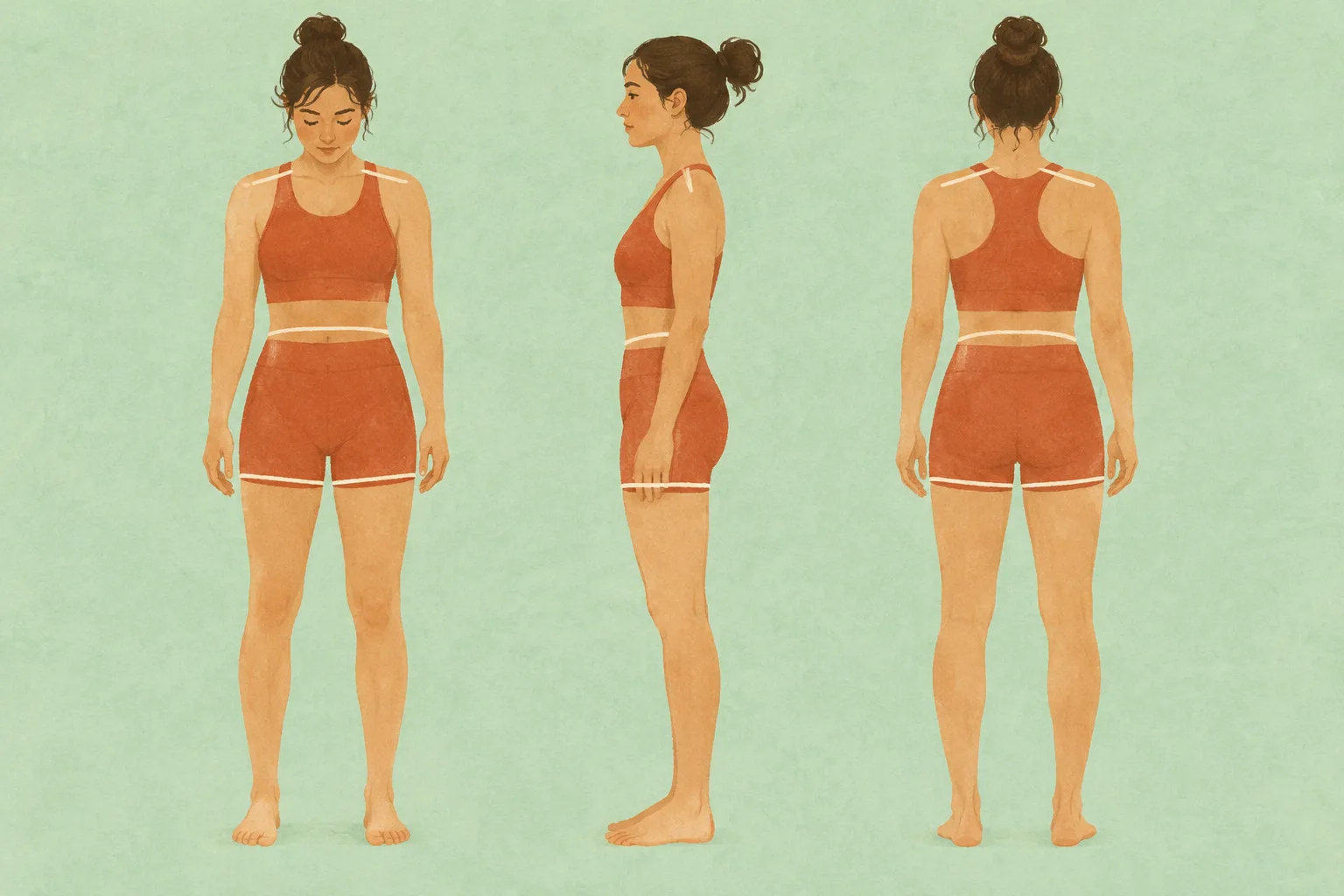
Fit in activewear comes down to a handful of measurements that do not change much between seasons: natural waist, hip at the widest point, ribcage just under the bust, and foot length measured at the end of the day. Writing these down once, in a note on a phone, removes most of the guesswork from future purchases and makes online shopping far less of a gamble.
The garment that fits is the one that disappears during the workout. Nothing shifts, nothing digs, nothing needs adjusting at the traffic light. That is the whole goal, and it is achievable with a tape measure, a mirror, and a willingness to do a squat in the changing room.