

Five Sneaker Styling Mistakes Quietly Ruining Your Outfit
A pair of sneakers can carry an entire outfit, and it can sink one just as quietly. The sinking rarely announces itself. There is no mirror moment, no alarm. A person leaves the house feeling assembled, catches a reflection in a shop window at noon, and cannot say why the whole thing reads flat. The shoes are new. The jeans fit. And yet.
Most of what goes wrong with sneakers happens in the gap between the shoe and everything above the ankle. Five mistakes account for a surprising share of that gap, and all five are small enough to fix in a hallway mirror before leaving.
The Pants That Swallow the Shoe
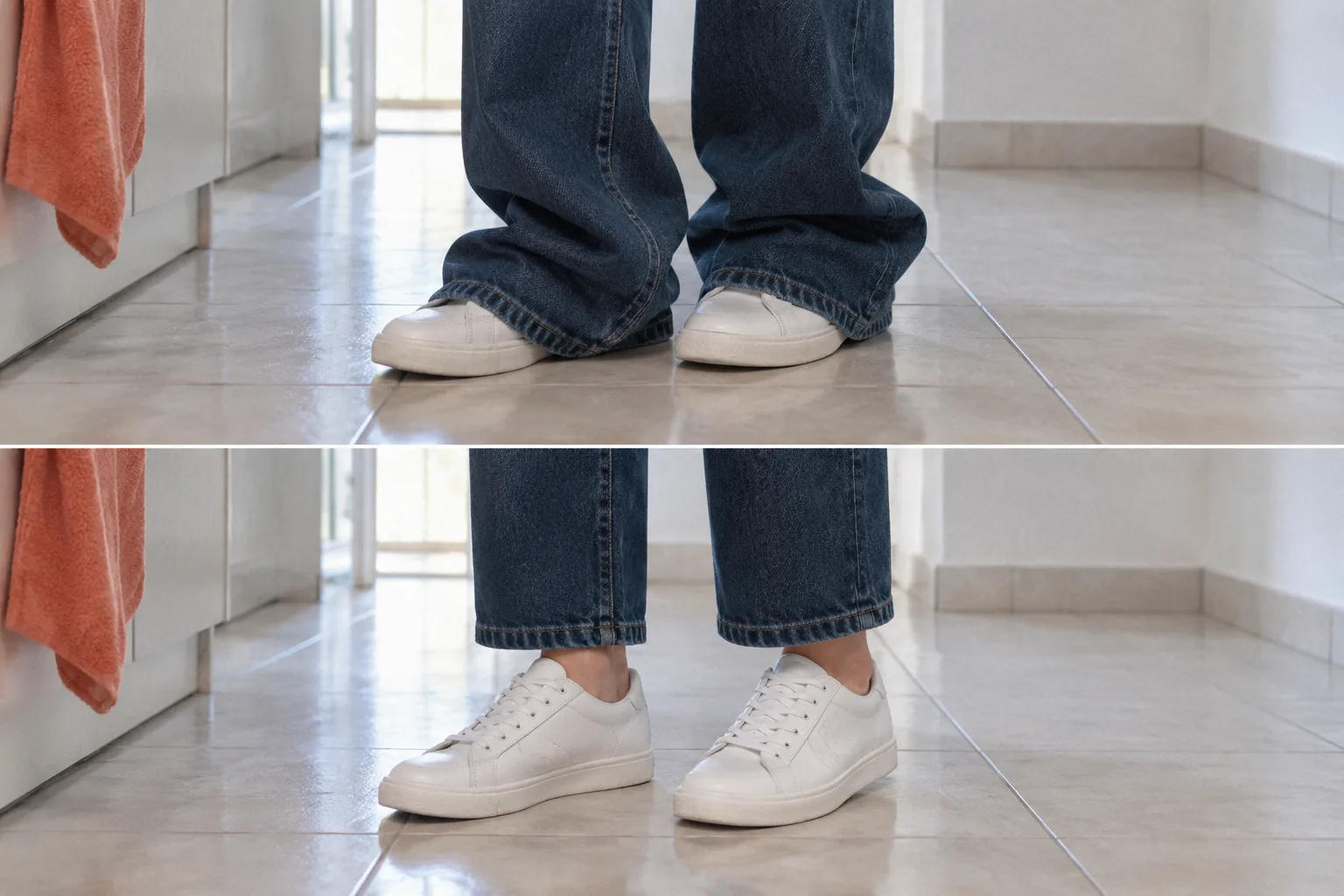
Denim that breaks low and bunches at the ankle is the most common offender. A hem that pools over the collar of a sneaker does two things at once: it hides the shoe's silhouette entirely, and it drags the eye downward to a shapeless heap of fabric. A wearer can spend real money on a clean low-top and reduce it to a dark smudge near the floor.
The fix is a hem that meets the shoe rather than covering it. For a slim or straight leg, a slight break, where the fabric just touches the top of the laces, lets the shoe read as part of the outfit. A cropped hem that shows a sliver of sock works better still with high-top styles, because the top of the shoe is doing the visual work and deserves to be seen.
Wide-leg trousers are a separate case. A generous hem can sit cleanly over a chunky sneaker if it falls straight, with no fold at the ankle. The difference between elegant and sloppy here is a half inch of length and whether the fabric has enough weight to hang.
The Sock That Interrupts the Line
Socks are the most overlooked piece of a sneaker outfit and the one most likely to break the line between trouser and shoe. A bright white athletic sock pulled up under a cropped trouser creates a hard horizontal stripe at the ankle that chops the leg into segments. A thin no-show sock under the same trouser lets the skin carry the line straight down into the shoe.
Neither choice is wrong in itself. The mistake is mismatch. A visible sock can be excellent with a high-top and shorts, where the sock is clearly a deliberate layer. The same sock under a tailored trouser looks like a forgotten detail. The question to ask is whether the sock is participating in the outfit or interrupting it.
Color matters less than contrast. A sock close to the trouser color disappears; a sock close to the shoe color blends downward; a sock that contrasts with both draws attention to the ankle. That can be the point, or it can be an accident.
Treating One Sneaker as Every Sneaker
A running shoe and a minimalist leather sneaker occupy different rooms in the same house. The running shoe, with its mesh panels and foam stack, has an athletic vocabulary. The leather low-top speaks in a quieter register. Wearing either with the wrong outfit is a category error, and it shows up as a subtle friction the wearer often feels before anyone else can name it.
A performance running shoe belongs with technical fabrics, joggers, shorts, and casual layers that share its energy. Put the same shoe under a wool trouser and the outfit argues with itself. The trouser says office; the shoe says track. The eye registers the conflict before the brain explains it.
The minimalist leather sneaker is the opposite problem. It can look bland under athletic layers, too dressed-down for the gym and too plain for the street. It wants chinos, denim, knitwear, a coat. Matching the shoe's register to the outfit's register is most of the battle, and it costs nothing.
The Wrong Proportion at the Ankle
Proportion is where sneaker styling gets genuinely tricky, because the ankle sits at the junction of three separate visual weights: the trouser leg, the shoe, and the sock or skin between them. When those weights are balanced, the outfit reads as intentional. When they are not, the eye snags.
A bulky, chunky sneaker under a slim tapered trouser creates a visual pyramid, wide at the floor and narrow at the knee, which can look top-heavy or bottom-heavy depending on the rest of the outfit. A slim canvas sneaker under a wide trouser can look like a toothpick holding up a curtain.
The workable rule is rough parity. A substantial shoe wants a trouser with some body, whether that is a straight leg, a wide leg, or a relaxed chino. A minimal shoe wants a trouser that does not overwhelm it. The ankle is a hinge, and hinges work best when both sides carry similar weight.
Chasing the Shoe Instead of the Outfit
Sneaker culture trains a particular reflex: buy the shoe first, then build around it. The limited drop, the collaboration, the colorway that sold out in minutes. That reflex produces a wardrobe of statement sneakers and a closet full of outfits that cannot host them.
A loud sneaker needs quiet around it. A person wearing a multicolored, high-contrast shoe with patterned trousers, a graphic tee, and a bold jacket has created a shouting match with no winner. The same shoe under plain denim and a solid tee becomes the single point of interest, which is what a statement shoe is for.
This is the quiet ruin: the outfit that contains a great shoe and no room for it. The shoe gets blamed for looking wrong when the surrounding clothes were the ones failing to give it space.
The White Sneaker That Stopped Being White
A white leather sneaker is one of the most useful objects in a wardrobe and one of the fastest to age badly. The scuff at the toe, the gray crease across the vamp, the yellowed midsole: each is small, and together they turn a crisp shoe into a tired one. A pair that once lifted an outfit starts to drag it down.
The mistake is not wearing white sneakers; it is letting a dirty pair do the job of a clean one. White leather wants a wipe after wear and a proper clean every few weeks. Canvas can be scrubbed. Suede needs a brush and a protector before the first outing, not after the first stain.
There is a middle ground worth naming: a deliberately worn sneaker, creased and softened, can look great with denim and a heavy knit. The distinction is between patina and neglect, and the eye can tell the difference. A shoe that has been cared for wears its age well. A shoe that has not wears its owner's indifference.
The Hem Length Nobody Measures
Hem length is the single measurement most sneaker outfits get wrong, and almost nobody measures it. A trouser bought off the rack is cut for a generic leg and a generic shoe. The hem that works with a dress shoe, breaking once over the instep, does not work with a sneaker, which sits lower and flatter.
The practical move is to put the trouser on with the sneaker it will actually be worn with and look at where the hem falls. If it touches the floor, it is too long. If it sits above the ankle bone, it is too short for a classic break but may be perfect for a cropped look. The correct length depends on the shoe and the intended silhouette, which is why a tailor's chalk mark taken with the right shoe on beats any size chart.
This costs a small alteration fee and fixes a problem that no amount of shoe shopping can solve. The hem is the frame around the shoe, and a frame that does not fit makes even a good picture look wrong.
The Outfit That Peaks at the Feet
There is a particular failure mode where the sneakers are the most considered part of the outfit and everything above them is an afterthought. The shoes are immaculate; the trousers are an old pair; the top is whatever was clean. The result is an outfit that looks like a display stand for footwear rather than a person dressed for a day.
The sneaker is a supporting player in most outfits, and supporting players work best when the lead is strong. A great shoe under a weak outfit reads as effort in the wrong place. The reverse, a plain shoe under a strong outfit, reads as confidence. The shoe does not need to be the loudest thing in the room to be doing its job.
Building from the feet upward is fine as a method. The mistake is stopping there. The outfit has to be finished at the collar, not the laces, or the whole thing reads as a sneaker on a mannequin rather than a person on a street.
None of these five mistakes requires new shoes to fix. They require a mirror, a tailor's number, and the willingness to look at the ankle as a hinge rather than an afterthought. The sneaker was never the problem. The space around it was.