

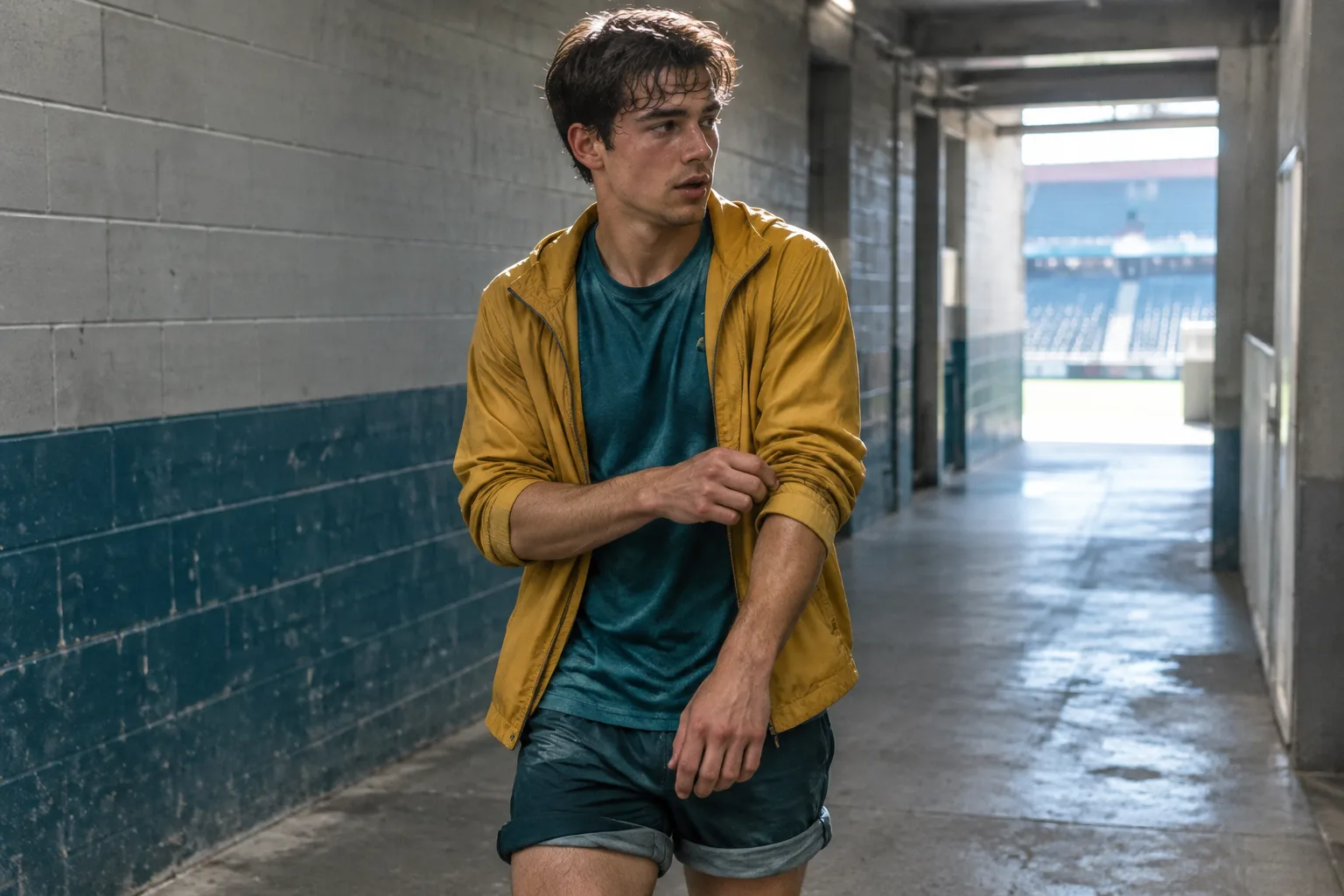
Less Locker Room, More Street: Small Moves That Shift the Read
The locker room smell is the first thing a player notices when the new kit comes out of the bag. Not sweat, not yet. Sizing. That faint chemical crispness of fabric that has never been worn, folded by a machine in a warehouse, and shipped in plastic. The jersey is beautiful in the way a showroom car is beautiful. Then it goes on a body, and the body starts to move, and the beauty either holds or it does not.
Most basketball apparel is designed for the locker room. It photographs well on a hanger, it hangs clean and square on a mannequin, and it looks correct in the tunnel walk before tip-off. What it does not always do is survive the actual game: the pivot, the reach, the landing, the sweat that soaks a collar by the second quarter. The gap between locker room and street is where a lot of athletic wear quietly fails, and it fails in ways a shopper never sees until the third wash.
The title of this piece is a claim, and the claim is simple. A few small moves in how a garment is cut, finished, and proportioned can shift the entire read of a basketball outfit, from something that looks borrowed from a team facility to something that looks like it belongs to a person walking down a city block.
Why the tunnel walk looks different from the street
Watch a player walk into an arena and then watch the same player, same body, walk out of a coffee shop in essentially the same clothes. The clothes have not changed. The read has. In the tunnel, the jersey is expected. The shorts are expected. The whole uniform is a costume the context has already agreed to. On the street, there is no context to lean on, and the garment has to do all the work by itself.
That is the first small move, and it has nothing to do with the garment at all. It is about acknowledging that a basketball uniform is a uniform, and a uniform is designed for a role. The street does not have a role. The street has weather, walking, sitting on a train, carrying a bag, and being looked at by people who did not agree to watch a game.
The hem is doing more work than the logo
Walk into any gym and count the jerseys that stop at the hip versus the jerseys that hang past the thigh. The difference in how the body reads is enormous. A jersey that ends at the hip makes the torso look short and the legs look like they begin somewhere near the ribs. A jersey that drops lower, even two inches lower, lengthens the whole line.
The same logic runs through the shorts. A pair of basketball shorts that hits just above the knee reads as athletic and intentional. A pair that hits mid-calf, the way most team-issued shorts do, reads as a uniform that has not been told the game is over. The small move is a hem adjustment of a couple of inches, and it moves the outfit from locker room to street more than any graphic on the chest.
Nobody needs a tailor for this. Buying a size down, or choosing a cut labeled shorter, gets most of the way there. The garment does not need to be altered. It needs to be chosen with the hem in mind.
Fabric weight and the afternoon sun
Basketball jerseys are built for air conditioning and hardwood. The mesh is light, the weave is open, and the whole thing is designed to move heat off a body that is running. On a street in July, that same mesh turns translucent in direct sun. The jersey that looked opaque under arena lights becomes a ghost of itself at 2 p.m., and the effect is not the athletic drape the wearer imagined.
A slightly heavier knit, or a jersey with a denser weave, holds its shape and its opacity and still breathes. It also drapes differently. Light mesh tends to cling and pool at the waist. A heavier fabric falls. That falling quality is what separates a garment that looks like performance gear from one that looks like clothing.
The trade-off is real. A heavier jersey is warmer. For a summer street fit, that matters. The move here is not to abandon mesh entirely but to notice the difference between mesh built for a game and mesh built for a look, and to pick accordingly. The label rarely tells the difference. The hand does.
The collar is the tell
Look at the neckline of a jersey that has been worn a dozen times. If it has gone soft and wavy, the collar was built to a price. If it still stands and holds its shape, the collar was built to a standard. This is one of the few places where construction quality is visible from across a room without anyone knowing they are looking at construction quality.
The small move is to check the collar before buying, and to favor a ribbed or reinforced neckline over a simple folded band. A reinforced collar reads as deliberate. A soft, floppy one reads as tired, and tired is the exact opposite of the street read the outfit is trying to achieve.
The same principle applies to the armholes. A raw or loosely finished armhole gapes and shows the side of the torso every time the wearer reaches for a bag strap. A finished armhole holds close to the body and keeps the line clean. These are the details nobody names in a product description, and they are the details that make one jersey look like a piece of clothing and another look like a giveaway.
Sleeves that stop where the arm does
Basketball has largely abandoned the sleeved jersey, but the sleeved basketball shirt, the one worn under a jersey or as a warmup layer, is everywhere on the street. The failure mode is consistent. The sleeve runs long and loose, past the elbow, and it swallows the arm and makes the torso look wider than it is.
A sleeve that ends just above the elbow, or a short sleeve that hugs the upper arm and releases at the bicep, changes the silhouette immediately. The arm reads as an arm instead of a tube. The shoulder line stays where the shoulder actually is. The small move is a couple of inches of sleeve length, and it does more for the look than a dozen accessories.
The sneaker that decides the whole outfit
Basketball footwear has spent the last decade getting taller, chunkier, and more aggressively technical, and the effect on a street fit is not neutral. A high-top with a thick collar and a sculpted sole pulls the whole outfit toward the court. A low-top, or a high-top with a slim collar, pulls the outfit toward the sidewalk. The shoe anchors the read more than the jersey does, because it is the piece closest to the ground and the one the eye lands on last.
The move is to choose the shoe for the street first and the game second, or to keep two pairs in rotation. The outfit does not need a different jersey. It needs a sneaker that tells the ground it is on the street.
Layering that reads as January, not as a warmup
The warmup jacket is the most misunderstood garment in basketball apparel. On a player, it is a functional layer for the bench and the tunnel. On the street, it is either a strong outer layer or a costume of a team that no longer exists, depending entirely on how it is worn. A zip-up warmup jacket over a jersey, both in team colors, reads as a uniform. The same jacket over a plain tee, in a single neutral color, reads as a jacket.
That is the whole trick. The warmup works on the street when it is styled as outerwear and fails when it is styled as a replica. The small move is subtraction: one team element per outfit, not three.
The proportion mistake that flatters no one
Baggy shorts and a baggy jersey together create a silhouette that is wider in the middle than at the shoulders and wider at the knees than at the hips. The body disappears inside the clothes. Basketball players can carry this because the body underneath is doing the work, but a person walking to a train does not have the same advantage, and the outfit reads as a bag with limbs.
The small move is contrast. If the shorts are relaxed, the top should be closer to the body. If the jersey is loose, the shorts should be cut closer to the leg. One relaxed element per outfit keeps the whole look from collapsing into a single volume.
What the street asks that the court does not
The street asks a garment to look like it was chosen. That is the whole ask, and it is a harder ask than it sounds. A uniform is chosen by a team, a league, and a season. A street outfit is chosen by a person, and the garment has to carry that choice visibly. The hem, the collar, the fabric weight, the sleeve length, the shoe, the layer, and the proportion are all small decisions that add up to a garment that looks chosen.
None of these moves requires a new wardrobe. Most of them are a size, a hem, or a fabric decision made at the point of purchase. The jersey that survives the third wash and the afternoon sun and the walk to the train is the jersey that was chosen for the street, not borrowed from the locker room.