

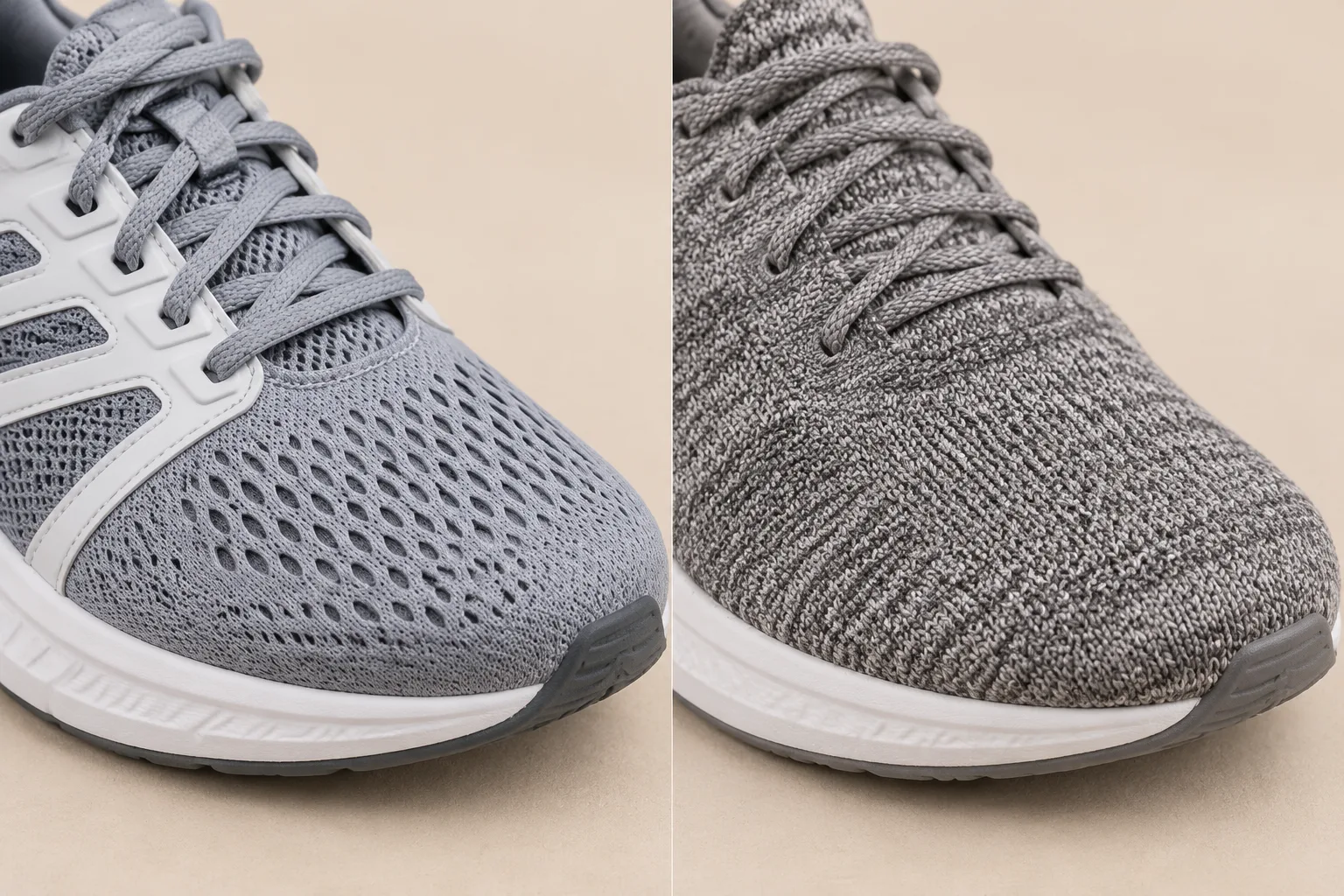
Mesh or Knit? Two Upper Materials, Two Very Different Shoes
Mesh and knit are two families of textile construction that both end up on the upper of a running shoe, and they behave so differently underfoot that a buyer who treats them as interchangeable will end up with the wrong shoe for the wrong purpose. The distinction is structural before it is aesthetic. Knit is a continuous looped yarn structure, stretchy in multiple directions, soft against the skin, and capable of wrapping the foot like a sock. Mesh is a woven or bonded network of holes, engineered for airflow and often reinforced with a backing layer or a synthetic cage. One moves with the foot; the other manages the space around it.
What Mesh Actually Is Under a Microscope
Mesh starts as a grid. The openings are the point: open-weave monofilament or multifilament yarns are woven, knitted, or heat-bonded into a sheet with a deliberate pattern of perforations, and the size and arrangement of those perforations are tuned to let heat and moisture escape. A typical running mesh upper, especially in the forefoot, carries a hexagonal or diamond cell pattern that looks almost like a screen door when held to the light. That is not decoration. It is the ventilation strategy.
The trade-off arrives immediately. A sheet full of holes has very little structural integrity on its own, so mesh uppers are almost always laminated to a backing or wrapped in a synthetic overlay. This is why a mesh shoe often has a slightly stiff, layered feel at the midfoot: the mesh provides breathability, and the cage provides lockdown. The toe box is where the mesh does its real work, and it is also where the material shows its limits. Sand and fine grit pass through open cells with depressing ease, and a mesh toe box that has seen 300 miles of trail often looks like it has been sandblasted.
What Knit Does That Mesh Cannot
Knit is a looped structure, and the loops are what make it elastic. A single continuous yarn feeds through a machine that forms interlocking loops, and the resulting fabric can stretch along the length, across the width, and diagonally without tearing. That multi-directional give is why knit uppers conform to the shape of a foot rather than asking the foot to conform to a pre-shaped shell. Slip a knit shoe on and the upper collapses around the arch and instep like a sock that has been tailored.
The comfort is real, and so is the consequence. Knit has no inherent holes, so breathability depends on how the yarn is spun and how openly the loops are formed. A dense knit runs warmer than a good open mesh. A loose knit breathes well but offers less support, and it will sag over time at the heel collar and the lateral forefoot where the foot pushes hardest. The material also holds moisture differently: knit absorbs sweat into the yarn and dries slowly, while mesh sheds it through the openings. On a humid summer run, that difference is noticeable by mile four.
The Lockdown Problem, Which Is Where Most Buyers Get Burned
Fit is where the two materials diverge most sharply in daily use. Mesh uppers are dimensionally stable. A size 10 mesh shoe stays roughly a size 10 through a marathon training block, and the midfoot cage keeps the foot from sliding laterally. The upper does not adapt to a narrow heel or a high instep, but it does not surprise the wearer either. What the shoe feels like on day one is close to what it feels like on day ninety.
Knit uppers are dynamic. They stretch to accommodate a wide forefoot and a high instep, which is a genuine gift for anyone who has spent years sizing up to avoid toe pressure. But that same give can allow the foot to drift inside the shoe on hard cuts and descents, and the heel collar of a knit shoe can loosen over months of use until the lockdown feels vague. Runners with narrow feet often find knit uppers too accommodating, and trail runners on technical ground frequently prefer the firmer, more predictable hold of mesh with a reinforced cage.
Where Each Material Belongs on the Road
For steady road miles in warm weather, a well-engineered mesh upper is hard to beat. The airflow is directed, the structure is predictable, and the shoe holds its shape across a full training cycle. This is the material of the daily trainer for good reason: it tolerates heat, it tolerates sweat, and it does not ask the foot to do any extra work to stay put. On a long, slow run in July, that ventilation is not a luxury.
Knit earns its place in two specific scenarios. The first is recovery and easy-day running, where comfort and a sock-like feel matter more than locked-down precision. The second is any foot shape that standard mesh uppers punish: wide forefeet, high insteps, a bunion that a stiff toe box would press against. A knit upper can be the difference between a shoe that is wearable and one that is not. Plenty of runners keep a knit pair for easy days and a mesh pair for workouts, and that division of labor makes sense.
Durability Follows Structure, Not Price
Mesh uppers tend to fail at the flex point over the toes and along the lateral edge where the little toe presses, and the failure mode is usually a tear that starts at a single cell and propagates. Knit uppers tend to fail by pilling, by losing tension at the collar, and by developing thin spots where the yarn has abraded against a sock or a gait cycle. Neither is dramatically more durable than the other in absolute terms. The difference is where the wear shows up and how soon it affects function.
A mesh tear at the toe is mostly cosmetic until it is not, and a knit that has gone slack at the heel is a fit problem the moment it happens. Buyers who run high mileage should inspect both materials at the same wear points, and should be honest about which failure they would rather live with.
Cleaning and Care Split the Two Materials Cleanly
Mesh responds well to a soft brush and a mild soap solution. The open structure lets water and dirt pass through, and the upper dries quickly on a shaded rack. The main risk is snagging a cell on a rough brush or letting mud dry into the perforations, which stiffens the sheet. A mesh shoe that is rinsed after a muddy run and air-dried will usually come back to something close to its original shape.
Knit is more forgiving to the touch and less forgiving to the wash. The loops trap fine grit, and a washing machine cycle can stretch the upper permanently. Hand washing in cool water and air drying away from direct heat is the safe route, and even then a knit upper tends to hold a faint odor longer than mesh because the yarn absorbs what the holes would have released. Anyone who sweats heavily will notice this by the end of a training block.
The Sock-Like Fit Comes With a Sock-Like Responsibility
The appeal of knit is that it asks very little of the wearer at the moment of putting the shoe on. There is no break-in period, no pressure point to negotiate, no stiff overlay digging into the instep on the first run. That immediate comfort is genuine, and it is why knit uppers have spread from running into walking shoes and casual sneakers where the wearer values feel over structure.
The responsibility is that knit does not hold a shape on its own. It relies on the last, the midsole, and often a hidden internal cage to give it a silhouette, and once those elements soften, the upper follows. A knit shoe that felt precise at purchase can feel like a slipper by month six. Mesh, for all its stiffness, tends to stay closer to what it was.
A Simple Decision Rule for the Shoe Rack
Match the upper to the job. A runner logging 40 to 60 miles a week on pavement in a warm climate should default to a mesh upper with a reinforced midfoot cage, because ventilation and dimensional stability are the two qualities that matter most across that mileage. A runner with a wide forefoot, a high instep, or a preference for easy-day comfort should keep a knit pair in rotation and accept the shorter structural lifespan as part of the deal.
The mistake worth avoiding is buying a knit shoe for speed work or a mesh shoe for a foot that needs give. Both materials are good at what they were engineered to do, and the shoe that fits the foot and the run will outperform the shoe that fits a trend. The upper is the part of the shoe closest to the skin, and it deserves the same scrutiny as the foam and the outsole.