

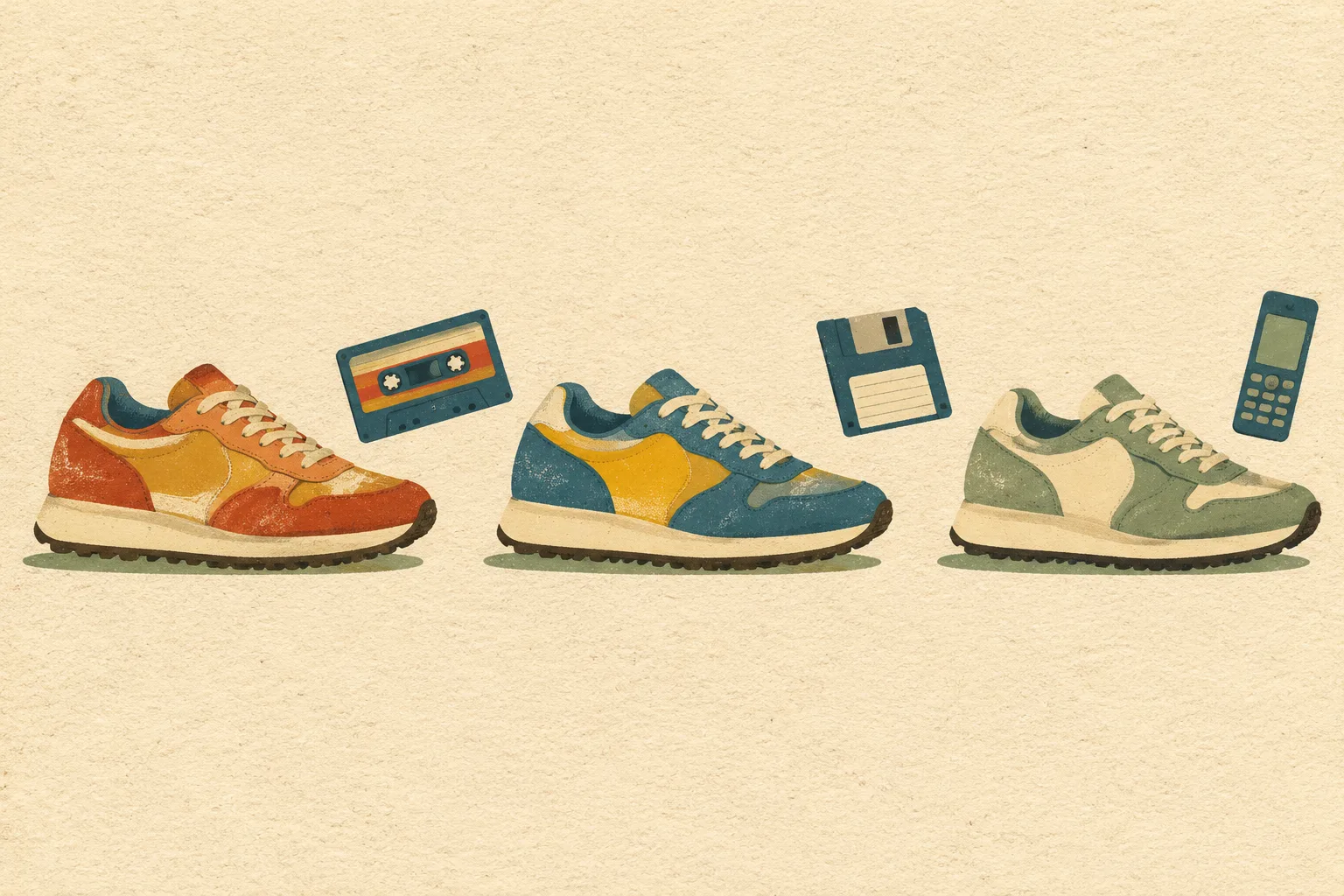
Retro Runners: The Sneakers That Age Better Than Trends
The sneaker that lasts is rarely the sneaker that turns heads in the year it arrives. It is the one sitting in a closet a decade later, still structurally sound, still recognizable, still earning a place on a foot. Retro running shoes occupy that strange middle ground in footwear culture: they were engineered as performance gear, retired from that job, and then quietly became something else, a wardrobe staple that outlives the trend cycle that briefly elevated it.
The category is loose but traceable. Think of the shoes that came out of running labs in the 1970s through the early 1990s and later got reissued: the New Balance 990 line, the Nike Air Max 90 and its Air Max siblings, the Adidas Samba and Gazelle lineage (which started in football, not running, but settled into the same retro vocabulary), the Asics Gel-Kayano and Gel-Lyte families, Saucony's Shadow and Jazz silhouettes. The precise roster matters less than the pattern. These shoes were built with a specific purpose, aged out of it, and found a second life.
The shoes that survive the trend cycle share something the trend-driven silhouettes do not: a reason to exist that predates the trend. The Air Max 90 was designed around a visible cushioning unit because Nike wanted to show off the technology. The 990 was built as a premium running shoe for people who took running seriously. That origin gives the shoe a visual logic, a proportion, a set of materials that were chosen for function. When the function fades, the logic remains legible.
Compare that to a shoe designed primarily to be noticed. The chunky dad shoe wave, the exaggerated platform, the deliberately ugly sneaker: these silhouettes work because they create a visual shock. The shock is the point. And shock, by its nature, has a shelf life. The shoe that was refreshing in one season becomes exhausting in the next, and then it sits in the closet, waiting for a nostalgia cycle that may or may not arrive.
Why the Old Running Shoe Still Looks Right
There is a proportion argument worth making here. Retro runners tend to sit lower to the ground than modern maximalist running shoes, with a flatter profile and a more modest stack height. That lower profile reads as more versatile across outfits. A low, slightly tapered shoe works with a straight-leg jean, a chino, a casual skirt, a pair of shorts. The high-stack, heavily cushioned shoe that dominates current running retail looks strange the moment it leaves the gym context, because its proportions were designed for a specific mechanical purpose.
Materials matter too. The classic retro runner is usually a mix of suede, mesh, and a rubber outsole, with a visible stitch line or two. These are materials that show wear in a legible way. A scuff on suede reads as patina. A crease in leather reads as character. A scratch on a glossy synthetic upper reads as damage, because the material was designed to look pristine and has no vocabulary for age.
This is the quiet reason so many retro runners get better with time. They were never meant to look perfect. The mesh panels yellow slightly, the suede softens, the midsole develops a faint compression line where the foot lands. The shoe accumulates a record of where it has been. That record is the thing trend-driven footwear cannot offer, because trend-driven footwear is designed to look new for exactly one season and then be replaced.
The Reissue Problem and What It Reveals
Reissues complicate the story. A shoe reissued in 2024 is not the same object as the shoe that came out in 1989, even when the model name matches. Materials get substituted, manufacturing moves, the midsole foam changes, the shape gets subtly altered to fit modern lasts. Sometimes the reissue is faithful. Sometimes it is a ghost of the original with the same name.
This matters for anyone thinking about longevity. The original shoe earned its reputation through a specific build. The reissue trades on that reputation. A person buying a retro runner today is often buying a shoe that has been engineered to look like the old one, not to perform like it. The distinction is worth holding onto, because it explains why some reissues feel wonderful and others feel hollow.
The shoes that age best tend to be the ones where the reissue stayed close to the source. New Balance's 990 series has kept a fairly consistent shape across generations, which is part of why the shoe has a stable identity. The Air Max 90 has been reissued so many times that some versions are noticeably different from others in materials and shape, and the difference shows up years later, when one pair has softened into something beautiful and another has just fallen apart.
The Colorways That Stay in Rotation
Color is where the trend cycle does the most damage. A shoe released in a loud, season-specific colorway has a short window. The gray-and-white New Balance 990, the black-and-white Samba, the white-and-navy Air Max 90: these are the colorways that survive because they were never trying to be the story. They were the background, and the background is what lasts.
There is a practical test here. A person considering a retro runner can ask whether the shoe would look reasonable in a photograph taken ten years from now. A neutral colorway with one accent almost always passes. A shoe with three competing colors and a gradient midsole almost always fails. The question is not about taste. It is about whether the shoe was designed to be a neutral object or a loud one.
This is also why the gray sneaker has become something of a modern uniform. The gray retro runner is the shoe equivalent of a navy blazer: it does not call attention to itself, it works with almost everything, and it looks slightly better after a few years of use. The people who wear a single gray pair for a decade are not making a fashion statement. They are making a decision about what to stop thinking about.
What the Retro Runner Sacrifices
Honesty requires acknowledging the trade-offs. A retro runner is not a good running shoe by current standards. The cushioning is thinner, the support is minimal, the materials are heavier than modern engineered mesh, and the fit is often less precise. Anyone planning to run more than a few miles should be looking at a current performance shoe, not a shoe designed in 1987.
The retro runner also tends to be narrower through the toe box and less forgiving for wider feet, because the lasts were built for a different era of foot measurement. And the durability is uneven. A suede toe cap will outlast a mesh panel by years, so the shoe can look tired in one zone while the rest of it is still fine.
None of this disqualifies the category. It just reframes it. The retro runner is a walking shoe, a daily shoe, a shoe for the commute and the errand and the long Saturday. Judged against that job, the trade-offs are mostly acceptable, because walking does not demand the same cushioning or energy return as running.
The Repair Question
A shoe that ages well has to be repairable, or at least resolable, or at least worth taking to a cobbler. This is where the retro runner has a structural advantage over many modern sneakers: the construction is often simpler. A stitched suede upper, a rubber cupsole, a standard lacing system. A good cobbler can replace a worn heel, patch a scuff, or reinforce a seam. The shoe has enough material and enough structure to accept repair.
Many modern performance sneakers are built with heat-bonded uppers and molded foam midsoles that are essentially impossible to repair. When they fail, they fail as a unit. The retro runner, by contrast, was built in an era when shoes were expected to be maintained, and that expectation left the object with more options.
This is the quiet economic argument for the category. A retro runner bought at full price and worn for eight years, repaired once or twice, costs less per year than three pairs of trend-driven sneakers bought and discarded. The math is not glamorous, but it is real, and it explains why so many people who care about clothing end up with a rotation of old running shoes.
The Pair That Outlasts the Closet Purge
Most wardrobes get purged every few years. The items that survive the purge tend to share a quality: they were never the loudest thing in the closet. They were the thing that worked, quietly, across enough outfits that removing them felt like a loss. The retro runner is almost always in that surviving pile, because it was designed to be useful before it was designed to be stylish.
The shoe that ages better than trends is the shoe that had a job before it had a look. The look is a byproduct of the job, and byproducts, unlike trends, do not expire. That is the whole reason a gray suede runner from 1991 can sit next to a pair of tailored trousers in 2025 and look like it belongs. It was never trying to belong. It was trying to run.