

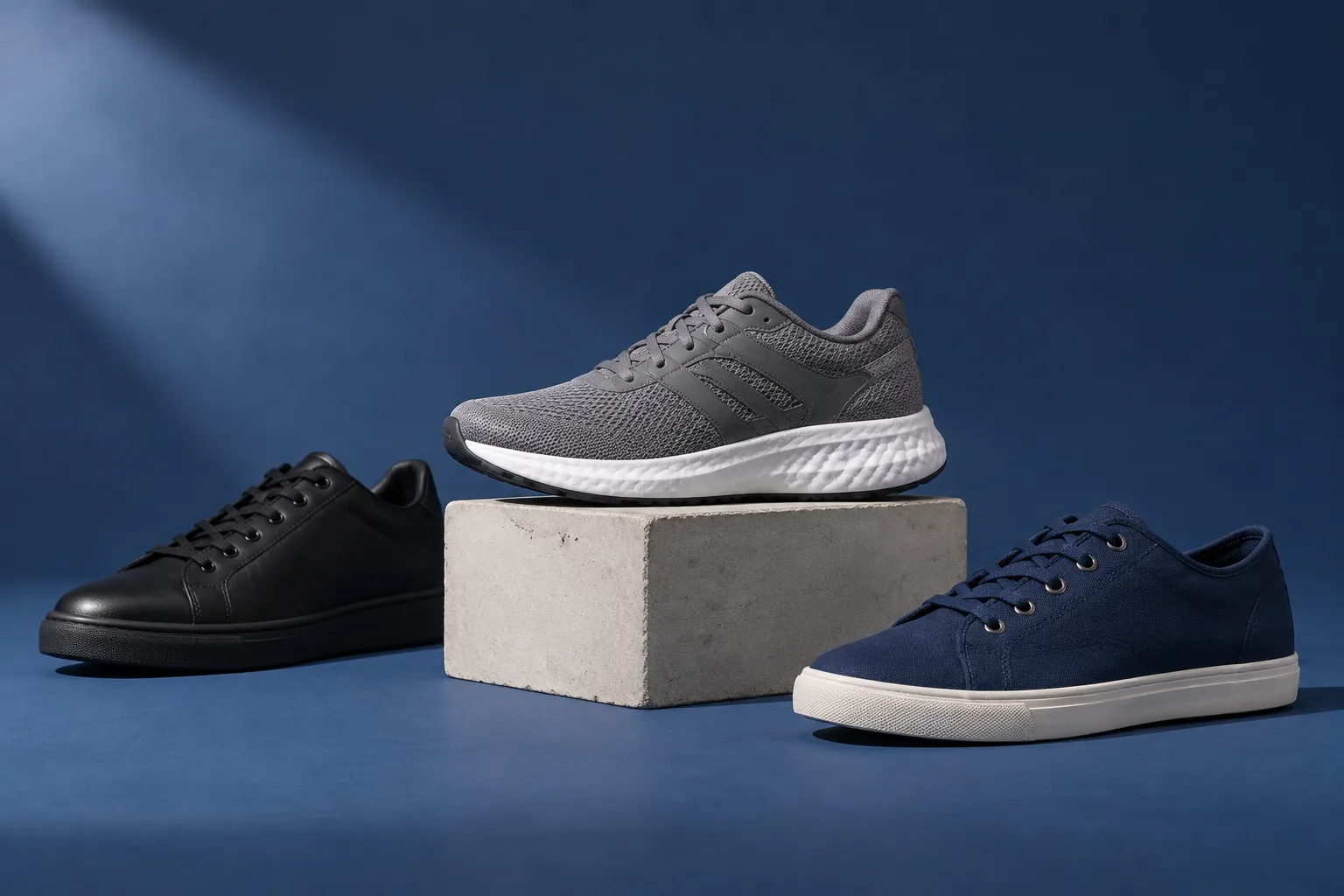
Shoe Color, Decided: A Logic for Sporty Fits
The white sneaker has become the default answer to nearly every casual outfit question, and that is exactly the problem. It works with everything, which means it says almost nothing. A grey running shoe with a white foam midsole flanked by a black leather sneaker on one side and a navy canvas shoe on the other tells a person far more about what to reach for than any style guide ever will. Shoe color in sporty outfits is a decision, and it deserves to be made deliberately rather than by reflex.
Sporty fits have a specific grammar. There is a technical layer, usually a shoe built for movement, and a casual layer, usually clothing built for sitting around. The shoe is the loudest element in that grammar because it sits at the bottom of the silhouette where the eye lands last and remembers longest. Color is the variable that either ties the two layers together or leaves them arguing. A pair of neon trail runners under a plain grey hoodie reads as intentional. The same shoes under a striped rugby shirt read as an accident.
The logic starts with a simple question about the shoe itself: does its color come from function or from decoration? A running shoe in fluorescent yellow is that color because visibility matters on a road at dusk. A lifestyle sneaker in the same yellow is that color because somebody in a design office thought it looked bold. The first reads as authentic to the sporty premise. The second reads as costume. That distinction is the foundation for everything else.
The Two-Color Ceiling
Most sporty outfits fall apart not because the shoe color is wrong but because there are too many colors competing for attention. A workable rule: the shoe should introduce at most one new color to the outfit, and that color should already exist somewhere above the ankle, even if only as a small detail. A navy shoe with a grey upper and a white midsole brings two colors, and the grey and white almost certainly appear in the clothing. A red shoe brings red, and if nothing else in the outfit is red, the shoe becomes a lone shout.
This is why black and white sneakers are so forgiving and so dull. They introduce no new color at all. They are the null hypothesis of footwear, and null hypotheses rarely make for interesting results. The ceiling of two colors is not a prohibition; it is a budget. Spend it well.
There is a practical test that costs nothing. Lay the outfit flat on a bed, shoes at the bottom, and step back. If the shoes are the only element of their color in the entire arrangement, they will look like they belong to a different outfit. If the color appears once more, even faintly, in a logo, a stripe, a sock, or a seam, the eye will connect them and the outfit will cohere. This is not mysticism. It is how visual grouping works.
Why Grey Beats White for Most Sporty Builds
White sneakers photograph beautifully and age badly. A white shoe in a sporty outfit draws the eye downward with the force of a spotlight, which is fine if the rest of the outfit can hold its own and disastrous if it cannot. Grey does the opposite. A grey suede or mesh runner sits quietly under a black track pant or a navy short and lets the clothing carry the silhouette. It reads as athletic without announcing itself.
Grey also absorbs the small indignities of actual wear. A white shoe that has been through a wet commute looks neglected. A grey shoe that has been through the same commute looks broken in. The color has a tolerance for reality that white does not, and sporty outfits are worn in reality more than they are worn in photographs.
The exception is a deliberately clean white shoe worn with an outfit that is equally clean: crisp track pants, a fresh tee, nothing wrinkled. In that context white is a statement of maintenance, and it works. The problem is that most people reach for white by default and then wear it with a wrinkled hoodie, which produces a shoe that is trying harder than the rest of the outfit.
The Case for One Loud Shoe
A single loud shoe can carry an otherwise plain sporty outfit, and this is the most underused move in the category. A bright orange or acid green runner under an all-black or all-grey base is a decision that reads as confident because the rest of the outfit has clearly stepped back to let the shoe speak. The mistake is pairing a loud shoe with a loud outfit, which produces noise rather than contrast.
The loud shoe works best when the clothing is genuinely plain, not merely subdued. A black hoodie, black joggers, and a fluorescent shoe is a legible composition. A black hoodie with a graphic print, black joggers with a stripe, and the same shoe is a collision. The loud shoe needs empty space around it, and empty space in an outfit means solid blocks of color with no competing detail.
There is also a seasonal logic here. Loud shoes read better in summer, when the outfit is smaller and the shoe has more visual room. In winter, when a sporty outfit involves a puffer, a beanie, and layers, a loud shoe fights the bulk. Dark, quiet shoes handle winter layering better because they recede under the volume above them.
Matching the Shoe to the Fabric, Not the Outfit
Most advice about shoe color focuses on the clothing colors, which misses a more reliable signal: fabric. A mesh runner has a matte, slightly translucent surface that pairs naturally with technical fabrics like nylon, ripstop, and jersey. A leather sneaker has a smooth, reflective surface that pairs naturally with cotton fleece and denim. Put a glossy leather sneaker under a shiny nylon track suit and the two surfaces compete. Put a mesh runner under the same track suit and the textures agree.
This is why a grey mesh runner looks correct with almost any sporty outfit made of synthetic fabric, while a grey leather sneaker with the same outfit looks slightly off even though the color is identical. The eye reads texture before it reads hue, and a mismatch in texture registers as a mismatch in color even when none exists.
The practical version: if the outfit is mostly technical fabric, choose a shoe with a matte or mesh upper. If the outfit is mostly cotton or denim, choose a shoe with a smoother upper. Color follows texture, not the other way around.
Socks as the Bridge Color
The sock is the most neglected color decision in sporty outfits and the cheapest to fix. A sock in a color that appears nowhere else in the outfit creates a hard line at the ankle that breaks the visual flow between shoe and leg. A sock that matches or closely echoes the shoe color extends the shoe upward and makes the whole lower leg read as one element.
For a grey shoe, a grey or charcoal sock makes the ankle disappear. For a black shoe, a black sock does the same. For a loud shoe, the interesting move is a sock in the same loud color, which turns the shoe and sock into a single block of color and makes the statement larger and more deliberate. A white sock under a loud shoe, by contrast, inserts a stripe of neutrality that dilutes the effect.
There is a limit. Socks that match the shoe exactly can look like a uniform choice, which is fine for actual athletic wear and slightly stiff for casual sporty outfits. A sock one shade off the shoe is usually better than an exact match, because it reads as considered rather than purchased together.
When the Shoe Should Disappear
Some sporty outfits are built around a piece of clothing that deserves the attention: a brightly colored track jacket, a patterned short, a distinctive hoodie. In those cases the shoe should be as close to invisible as possible. A dark grey or black shoe with no visible branding and a low profile lets the clothing carry the outfit without competition from below.
This is the inverse of the loud-shoe rule, and the two rules together cover most situations. Either the shoe speaks and the clothing steps back, or the clothing speaks and the shoe steps back. The failure mode in both cases is the same: everything speaking at once.
A person who has one quiet dark shoe and one loud statement shoe in the rotation can handle nearly every sporty outfit that comes up. The quiet shoe handles the days when the clothing is the point. The loud shoe handles the days when the outfit is plain and needs a single decision to make it interesting. Two pairs, two jobs, and the color question answers itself.
The Shoe Color That Ages With the Outfit
Sporty outfits are worn hard and washed often, and the shoe color that survives that treatment is the one worth buying. Bright dyed leathers fade unevenly. White mesh yellows at the collar. Grey suede develops a patina that reads as character. Black leather scuffs into something softer. The colors that age well in a sporty context are the ones that were slightly muted to begin with.
A shoe bought in a color that only looks right when new is a shoe that will spend most of its life looking wrong. The better question than "does this color match this outfit today" is "will this color still match this outfit in a year, after forty wears and a dozen washes." Muted grey, charcoal, black, and navy pass that test. Neon and pristine white generally do not.
The final decision is simpler than the analysis suggests. Pick a shoe color that either repeats something already in the outfit or introduces exactly one new color on purpose. Match the texture of the shoe to the texture of the clothing. Use the sock to extend or contrast the shoe deliberately. And buy the version of the color that will still look right after a year of real wear, because that is the only version that will actually be worn.