

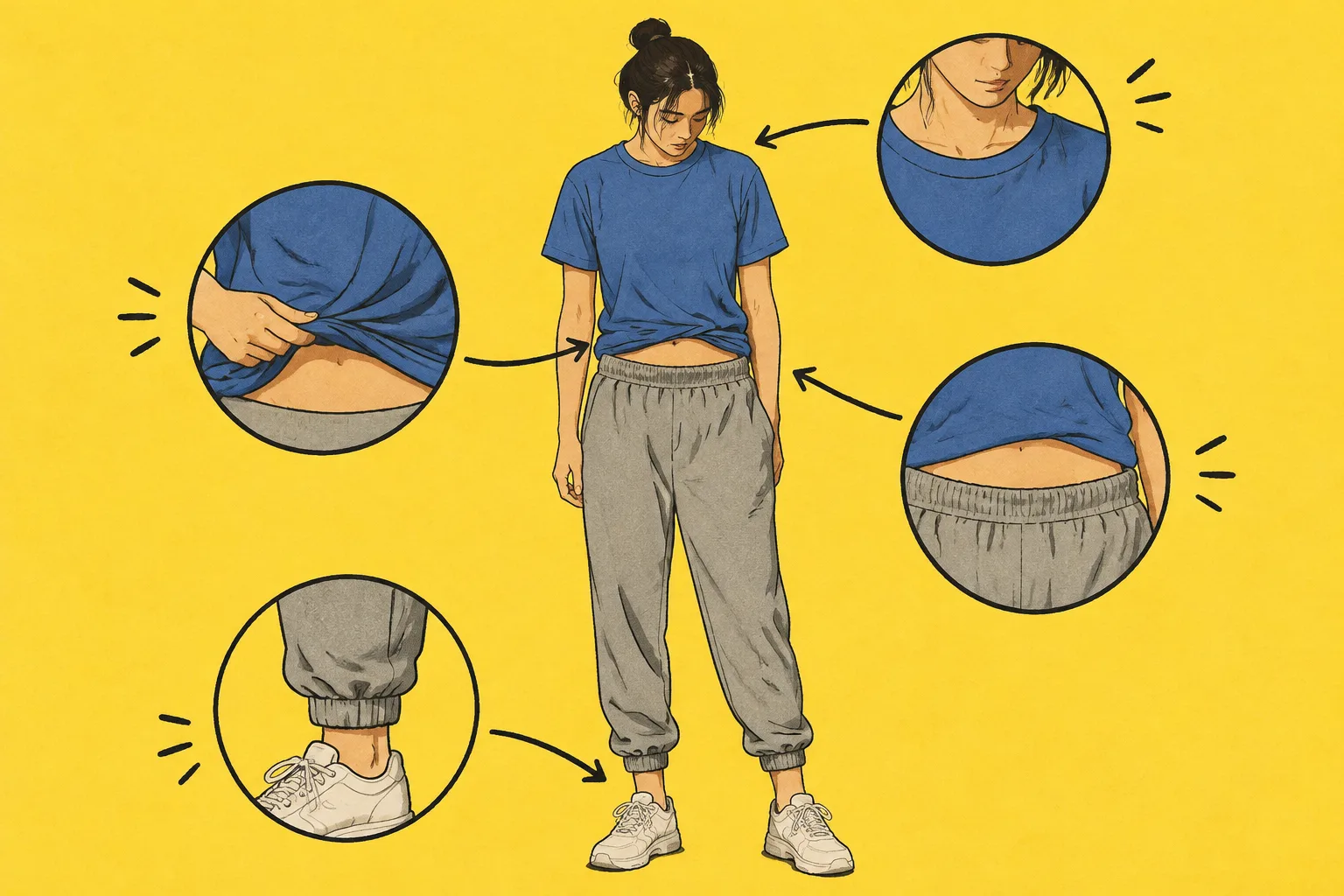
Small Slips That Sink a Sporty Fit
The gym mirror is unforgiving in a very specific way. A man can spend forty minutes on a leg press and still walk out looking like he borrowed someone else's shorts, because the shorts are doing something wrong at the hem. A woman can own a matching set that cost more than a decent dinner and still catch her reflection mid-lunge and wince, though she could not immediately say why. The fabric is fine. The color is fine. Something at the edges is off, and the edges are where a sporty fit lives or dies.
Athletic clothing is a genre built on small tolerances. The distances involved are measured in centimeters, sometimes millimeters, and the body is in motion the whole time, which means every slack seam and every extra inch of fabric gets multiplied by a thousand repetitions. A cotton t-shirt can be a little loose and nobody notices. A running top that rides up two inches over the course of a five-kilometer jog is a different animal entirely, and by the end of the run the wearer has adjusted it roughly four hundred times.
The slips that sink a sporty fit are rarely dramatic. Nobody looks at a photo and says "the sleeve was half an inch too short." But the wearer feels it. The outfit never quite settles, and the person inside it never quite relaxes, and that low-grade distraction reads to everyone around as something being wrong without anyone being able to name it.
The hem that hits mid-calf
Shorts are the most common casualty. The fashion world has spent a decade pushing ever-shorter running shorts and ever-longer baggy ones, and both extremes have their place, but the trouble starts when a short bottom lands at a length the leg was not designed to bend around. A hem that stops just below the knee on a squatting body will bunch, roll, and creep. A hem that stops just above it will flap upward on every stride. The sweet spot tends to be either well above the knee, where there is nothing to catch, or far enough down the thigh that the fabric has room to move without meeting the joint.
There is also the matter of the liner. Built-in liners are a gift when they fit and a quiet ordeal when they do not. A liner with too much slack migrates. A liner with too little digs. Neither problem shows up in the changing room mirror, because both only announce themselves once the wearer is twelve minutes into a run and far from any place to fix anything. The fix, when shopping, is to test the short with a few deep squats and one vigorous lunge before committing. If the liner shifts, it will shift worse under real load.
Sleeves that stop in the wrong place
Sleeve length gets treated as a style choice, and in casual wear it mostly is. In athletic wear, it is a mechanical decision. A short sleeve that ends right at the bicep, where the muscle swells and contracts with every rep, will ride up within minutes of any lifting session. A sleeve that ends just past the elbow will bind on the forearm during pressing movements. The clean solution is a sleeve that ends either high enough on the arm that the muscle never reaches it, or low enough that the elbow can flex freely underneath.
Long sleeves have their own trap. A running top with a sleeve that reaches the wrist but does not have a thumb loop or a snug cuff will slide down over the hand during any arm swing, and a hand buried in fabric cannot grip a bar, hold a water bottle, or check a watch. The cuff is the whole game. A simple elastic band, a slightly tapered cut, or a proper loop turns a floppy long sleeve into a functioning piece of gear. Without one of those, the sleeve is decoration.
Waistbands that roll under load
A waistband is a structural element pretending to be a detail. On leggings and athletic trousers, the band has to hold position against the pull of movement, and the way it fails is almost always the same: it rolls. A rolled waistband creates a lump under the shirt, a line across the midsection, and a constant urge to tug. The roll happens for a few reasons. The band may be too narrow, so the fabric has no leverage to stay flat. It may be too wide and too soft, so it folds instead of gripping. Or the rise may be wrong, sitting too low on the hips so that every bend of the torso drags it down and every extension pushes it up.
The tell, when trying a pair on, is a forward fold and a slow twist. If the band stays put through both, it will probably survive a workout. If it shifts even slightly in the fitting room, it will be in open rebellion by the second set. Wide, firm, and slightly compressive is the reliable combination, and it is worth paying for. A cheap waistband is the most expensive thing in an athletic wardrobe, because it turns every session into a small negotiation.
The sock gap and the shoe seam
Ankle socks that slide below the heel of a running shoe leave a strip of bare skin exactly where the shoe collar rubs. This is the sock gap, and it produces a blister in the same place every single time, because the shoe does not move and neither does the friction. No-show socks are the usual culprit, and the ones that fail are the ones with too little silicone grip at the heel or too shallow a cut over the instep. A slightly higher sock, one that clears the collar of the shoe by a comfortable margin, removes the problem entirely, and the aesthetic cost is close to zero.
Shoes have a parallel problem at the seam. A shoe that fits well in the store can still produce a hot spot on the outside of the little toe if the upper has a stitched overlay in the wrong place. The stitch line does not move, the foot does, and the result is a friction point that announces itself around the two-mile mark. When trying shoes, the move is to walk on a hard surface and feel for any ridge pressing against the foot, then to do it again with a thin sock and a thick one. The overlay that feels fine at rest is often the one that bites at speed.
Fabric weight that fights the body's own heat
Sporty outfits are usually chosen for how they look in a photograph, and photographs do not show heat. A heavy cotton-blend top photographed on a model looks substantial and flattering. On a body that is actually moving, it holds sweat against the skin, clings at the lower back, and turns a light workout into a damp, uncomfortable slog. The reverse error is just as common: an ultra-light fabric that looks technical and airy but has so little structure that it clings to every contour the moment any moisture appears.
The middle ground is a fabric with enough weight to hang cleanly and enough wicking to move moisture away. This is not a matter of brand or price, though the two often correlate. It is a matter of how the cloth behaves when a hand is dampened and pressed against it. If the fabric immediately sticks and turns translucent, it will do the same on a sweating back. If it stays opaque and releases, it will behave.
The pocket that cannot hold a phone
A phone in a loose athletic pocket bounces with every stride, and a bouncing phone is a small, constant interruption that ruins the rhythm of a run or a set. Side pockets on shorts and leggings are often cut too shallow or too loose to secure a device, and the result is a hand pressed against the hip for the entire session. A zip pocket, a deeper angled pocket, or a proper phone pouch built into the waistband solves this, and the difference between a pocket that works and one that does not is immediately obvious the first time it is used under motion.
The test is simple and slightly undignified: put the phone in, jump twice, and jog in place for ten seconds. If the phone has moved more than a finger's width, the pocket is decorative. Clothing built for movement should be tested in movement, and the fitting room mirror, which only shows a body at rest, cannot do the job.
Why the eye catches these faults before the mind does
People are remarkably good at reading posture and movement, and remarkably bad at articulating what they are reading. A rolled waistband, a creeping hem, a sleeve that has slid over a hand, and a sock that has slipped below a shoe collar all produce the same visual signal: a person who is adjusting rather than moving. The adjustment is the tell. It reads as discomfort, as distraction, as a body that is not quite at home in its clothes, and it undercuts the confident, athletic impression the outfit was supposed to create.
This is why small slips matter so much more in sporty clothing than in almost any other category. A slightly long sleeve on a blazer is a style note. A slightly long sleeve on a running top is a hand that cannot grip a bar. A slightly loose waistband on jeans is a belt situation. A slightly loose waistband on leggings is a session spent tugging. The margin for error in athletic wear is narrow because the body is asking the fabric to do real work, and fabric that does not do its work forces the body to compensate.
The thirty seconds that save the whole outfit
None of this requires a lab or a spreadsheet. It requires a fitting room and roughly thirty seconds of honest movement before any athletic purchase. Squat deep. Twist the torso. Raise both arms overhead and lower them. Jog in place. Swing the arms as if running. Bend forward and reach for the floor. Watch what shifts, what rolls, what rides, and what clings. The pieces that stay put through that sequence are the pieces that will disappear during a real workout, and the pieces that disappear are the ones that let the body do what it came to do.
There is a particular pleasure in a sporty outfit that has been tested this way. Nothing announces itself. The hem stays at the thigh, the cuff holds the sleeve, the waistband stays flat, and the person inside the clothing stops thinking about the clothing entirely. The workout becomes the only thing in the room. That is the whole point of athletic wear, and it is achieved or lost in centimeters.