

Sock and Sneaker Mismatches That Undo a Good Fit
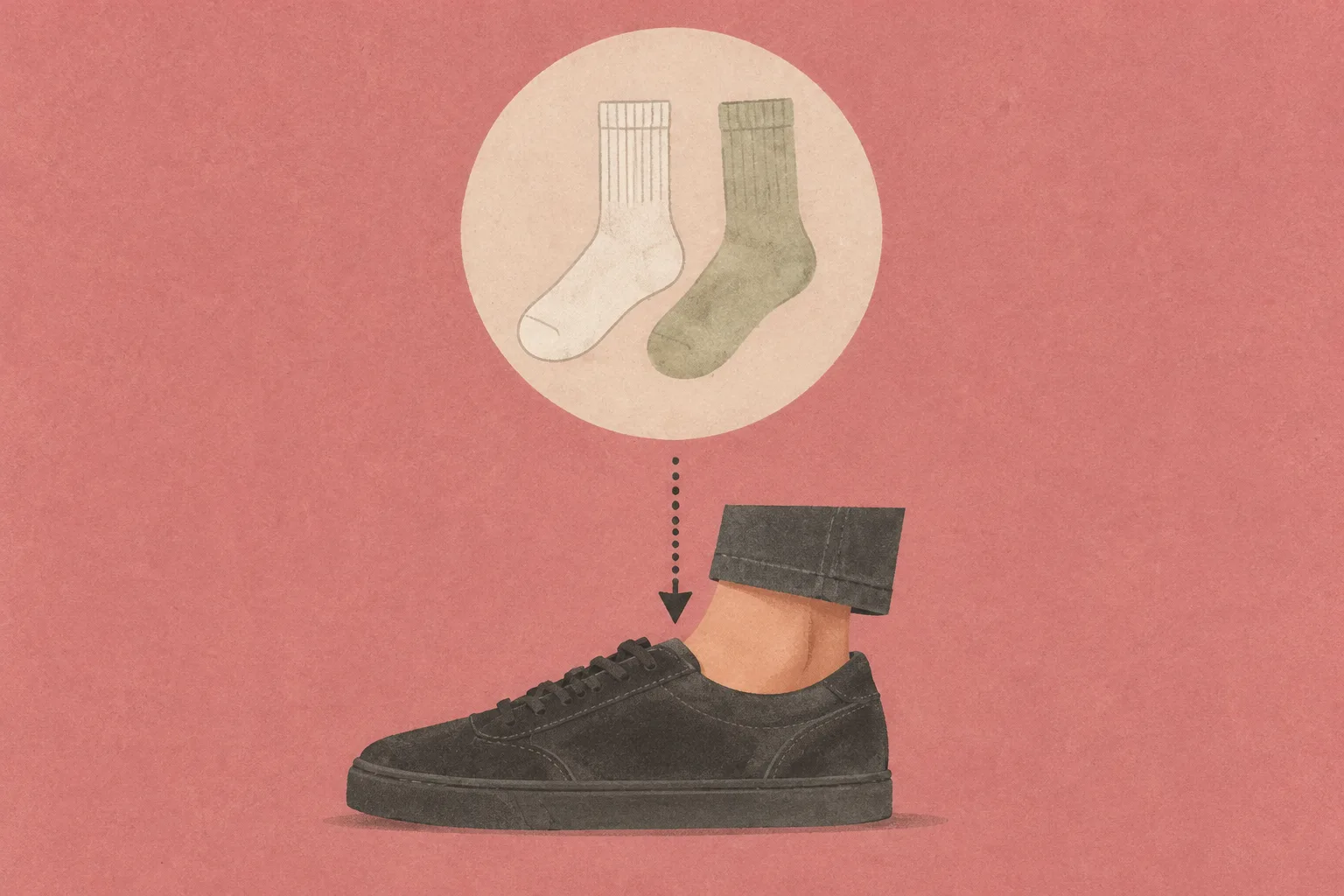
The sneaker is charcoal suede, low profile, clean toe box, the kind of shoe that costs real money and signals a certain restraint. The sock is white cotton, crew height, slightly yellowed at the heel. The combination is everywhere, and it ruins the shoe. Not the shoe's fault. Not even the sock's fault, exactly. The mismatch is a category error, a small failure of attention that undoes an otherwise competent outfit in a way the wearer rarely notices and everyone else does.
Sock and sneaker mismatches are not about fashion rules. They are about proportion, color temperature, texture, and the specific relationship between the ankle and the shoe's collar. Get one of those wrong and the whole lower leg reads as an afterthought. Get all four wrong and the outfit reads as a person who dressed in the dark.
The white crew sock under a low-profile sneaker
This is the most common mismatch, and the most forgivable, which is why it persists. A white crew sock under a slim low-top sneaker, the sock rising two or three inches above the collar, creates a hard horizontal line at the ankle that cuts the leg. The shoe is designed to be low and quiet. The sock is loud and tall. The two fight.
There is a version of this that works: the white crew sock pushed down into a soft slouch, worn with a chunky sneaker, the sock peeking out unevenly. That is a deliberate look with a sloppy charm. The mismatch happens when the sock is pulled taut and the sneaker is sleek. Then the sock looks like it belongs to a different outfit, and the sneaker looks like it is being worn by someone who does not own ankle socks.
The fix is not complicated. A no-show sock under a low-profile sneaker, or a sock that matches the shoe's color temperature closely enough to disappear. The white crew sock has its place. That place is not under a suede low-top with a crepe sole.
Black socks with white sneakers and the gray zone they create
A black sock under a white leather sneaker is a specific kind of visual violence. The white shoe is bright, the sock is dark, and the contrast at the collar is so sharp that the eye cannot settle. The ankle becomes a hard edge. The leg above the sock looks disconnected from the foot below it.
There is a practical argument for black socks: they hide dirt, they read as formal, they pair with dark trousers. All true. But under a white sneaker, the black sock creates a gray zone at the ankle where the eye expects continuity. The shoe is trying to be clean and casual. The sock is trying to be invisible and formal. Neither wins.
The same problem appears in reverse with a black sneaker and a white sock, though it is less jarring because the white sock reads as athletic and the black sneaker reads as athletic, and the two at least share a register. The white sneaker and black sock share nothing. They are from different dress codes, and the ankle is where the argument happens.
The sock that is too thick for the shoe's collar
A thick wool sock under a slim canvas sneaker is a mismatch of volume. The shoe has a narrow collar and a low profile. The sock is bulky, and it spills over the edge of the shoe in a way that makes the foot look swollen. The shoe is trying to be light. The sock is trying to be warm. The result is a foot that looks like it is wearing two different seasons.
This mismatch is common in transitional weather, when the morning is cold and the afternoon is warm, and the wearer reaches for the thick sock out of habit and the canvas sneaker out of optimism. The shoe was designed for a thin sock or no sock at all. The thick sock changes the shoe's silhouette, widening the ankle and shortening the visible length of the foot. A person can wear the same sneaker for years and never realize that the sock is the reason the shoe looks different on some days.
The collar of a sneaker is a fixed shape. A sock that exceeds the collar's capacity does not just look wrong; it distorts the shoe. The canvas stretches. The heel counter softens. The shoe ages faster because the sock is putting pressure where the shoe was not built to take it.
When the sock color matches the trouser but not the shoe
A navy sock under a gray sneaker, chosen because the sock matches the navy trousers, is a mismatch that looks almost right. The logic is sound: the sock extends the line of the trouser, creating a continuous column of color from knee to ankle. The problem is the shoe. The gray sneaker interrupts the column at the bottom, and the navy sock suddenly looks like it is trying to be a trouser and failing.
This is the mismatch of the well-dressed person who has learned one rule and applied it too broadly. Matching the sock to the trouser works with dress shoes, where the shoe is dark and the sock disappears into the shoe's shadow. With a light-colored sneaker, the sock has nowhere to hide. The trouser-sock column ends abruptly at the shoe's collar, and the eye reads the break as a mistake.
The better move with a light sneaker is a sock that matches the shoe or the skin, not the trouser. The trouser can end where it ends. The ankle does not need to be an extension of the leg if the shoe is doing something different.
The patterned sock that fights the sneaker's texture
A striped sock under a textured sneaker, say a knit or a mesh, is a mismatch of visual noise. The sock has a pattern. The shoe has a texture. Both are competing for the eye's attention at the same point on the body, and the result is a kind of static. The ankle becomes busy in a way that feels unintentional.
Patterned socks work best with plain shoes, where the sock is the only thing happening at the ankle. A solid leather sneaker, a smooth canvas slip-on, a clean low-top: these give the patterned sock room to be the detail. A textured sneaker already has a detail. Adding a patterned sock is like wearing a striped shirt with a plaid jacket. The pieces are fine on their own. Together they cancel each other out.
The ankle sock that disappears under a high-top
A no-show sock under a high-top sneaker is a mismatch of expectation. The high-top covers the ankle. The no-show sock is designed to be invisible under a low shoe. Together, they create a gap: the high-top's collar sits against bare skin, and the sock, hidden below, does nothing. The wearer thinks the sock is doing its job. It is not.
The high-top needs a sock that rises above the collar or a sock that is deliberately hidden but still provides a layer between the shoe and the skin. A no-show sock under a high-top is a sock that has been defeated by the shoe. The shoe's collar rubs against the ankle. The sock, buried below, cannot help. The mismatch is functional as well as visual: the high-top was designed to be worn with a sock that reaches the collar, and the no-show sock leaves the ankle exposed to the shoe's edge.
The fix is a crew sock that sits just above the high-top's collar, in a color that either matches the shoe or provides a deliberate contrast. The high-top is already a statement. The sock can support it or stay quiet. What it cannot do is hide.
The dress sock under an athletic sneaker
A thin dress sock, the kind with a smooth finish and a subtle sheen, under a running shoe is a mismatch of purpose. The dress sock is built for a leather shoe with a closed lacing system and a heel that does not move. The running shoe is built for motion, with a padded collar and a flexible upper. The dress sock slides. The running shoe grips. The two are not speaking the same language.
The visual result is a sock that looks too thin and too formal for the shoe, and a shoe that looks too casual for the sock. The ankle reads as unsettled, as if the wearer grabbed the first sock in the drawer and the first shoe by the door. That may be exactly what happened. The outfit still suffers for it.
Athletic sneakers want athletic socks, or socks that are thick enough to fill the shoe's collar and soft enough to move with the foot. A dress sock under a running shoe is a sock that has been reassigned to a job it was not trained for.
The sock that is the wrong length for the shoe's cut
Sock length is a spectrum, and every sneaker sits somewhere on it. A low-cut sneaker wants a no-show or a sock that sits below the collar. A mid-cut wants a sock that meets the collar or rises just above it. A high-top wants a sock that reaches the top of the shoe or disappears entirely beneath it. A sock that falls between these categories, too tall for the low-cut and too short for the high-top, creates a visible band of sock at the ankle that looks like a mistake because it is one.
The most common version of this mismatch is the quarter sock under a low-top sneaker. The quarter sock rises just above the shoe's collar, creating a small band of sock that is neither hidden nor deliberate. It is the sock equivalent of a shirt tail that has come untucked. The wearer does not notice. The eye does.
The fix is to commit. Either the sock disappears below the collar or it rises high enough to be a choice. The in-between length is the one that reads as an accident.
The mismatch that matters most is the one at the collar
Every mismatch in this list comes back to the same point: the collar of the shoe, where the sock and the shoe meet. That is where the eye goes first, because it is the transition point between the shoe and the leg. A clean transition reads as intentional. A messy transition reads as careless, even when the rest of the outfit is careful.
The collar is also where the shoe's design is most visible. A sneaker's collar is shaped, stitched, and finished with a specific height and curve in mind. A sock that covers the collar hides the shoe's design. A sock that sits below the collar leaves the design exposed. A sock that cuts across the collar disrupts it. The sock and the shoe have to agree on where the collar ends and the leg begins.
That agreement is the whole game. A person can spend an hour choosing the sneaker and thirty seconds choosing the sock, and the thirty seconds will decide whether the hour was worth it. The shoe is the statement. The sock is the punctuation. Get the punctuation wrong and the statement reads as a question.
The next time a pair of sneakers looks off, before blaming the shoe, check the collar. The sock is probably the reason. It is almost always the reason.