

Styling Slips That Make Activewear Look Sloppy
Gym clothes have spent the last decade getting better at their actual job. Fabrics breathe, seams are flat, waistbands hold. The styling around them has not kept pace. A person can spend eighty dollars on a pair of training shorts and undo the whole purchase with a single wrong accessory, a hem that bunches at the ankle, or a top that was designed for a different activity entirely. The failures are small and they compound: a sloppy outfit rarely has one obvious flaw, it has four quiet ones that together telegraph "I grabbed whatever was clean."
The slips below are the ones that show up most often, on the street and in the studio, and each one is fixable in under a minute once it is named.
The Waistband That Was Never Meant to Be Seen
Compression tights and leggings are built with a wide, flat waistband because it stays put during movement. That waistband is doing structural work, and it is not designed to be the focal point of anything. When it gets worn with a cropped top that stops three inches above it, the seam line and the label and the drawstring all get promoted to the front of the outfit, and the effect is a person who forgot to finish getting dressed.
The fix is a top long enough to skim the top edge of the band, or one cropped so far above it that the gap reads as intentional. The awkward middle, where the crop lands just above the waistband, is where most of the sloppiness lives. A top that ends at the hip bone, a tank that tucks without bunching, or a cropped layer that overlaps the band by a couple of inches all resolve it.
Socks That Disappear Inside the Shoe
The no-show sock is a good invention with a bad failure mode. It slides down during a walk, bunches under the arch, and by the time a person reaches the coffee shop the heel is bare and the sock is a lump near the toes. From the outside the shoe looks fine. From the inside it is a mess, and anyone who has worn it knows the small, constant discomfort of a sock that has given up.
Low-cut socks with a silicone heel grip and a slightly higher back stay put through most of a day. For anything involving actual training, a quarter sock that shows a clean band above the shoe is the safer choice. Visible sock is not a styling error; a sock that has collapsed into the shoe is.
Leggings That Puddle at the Ankle
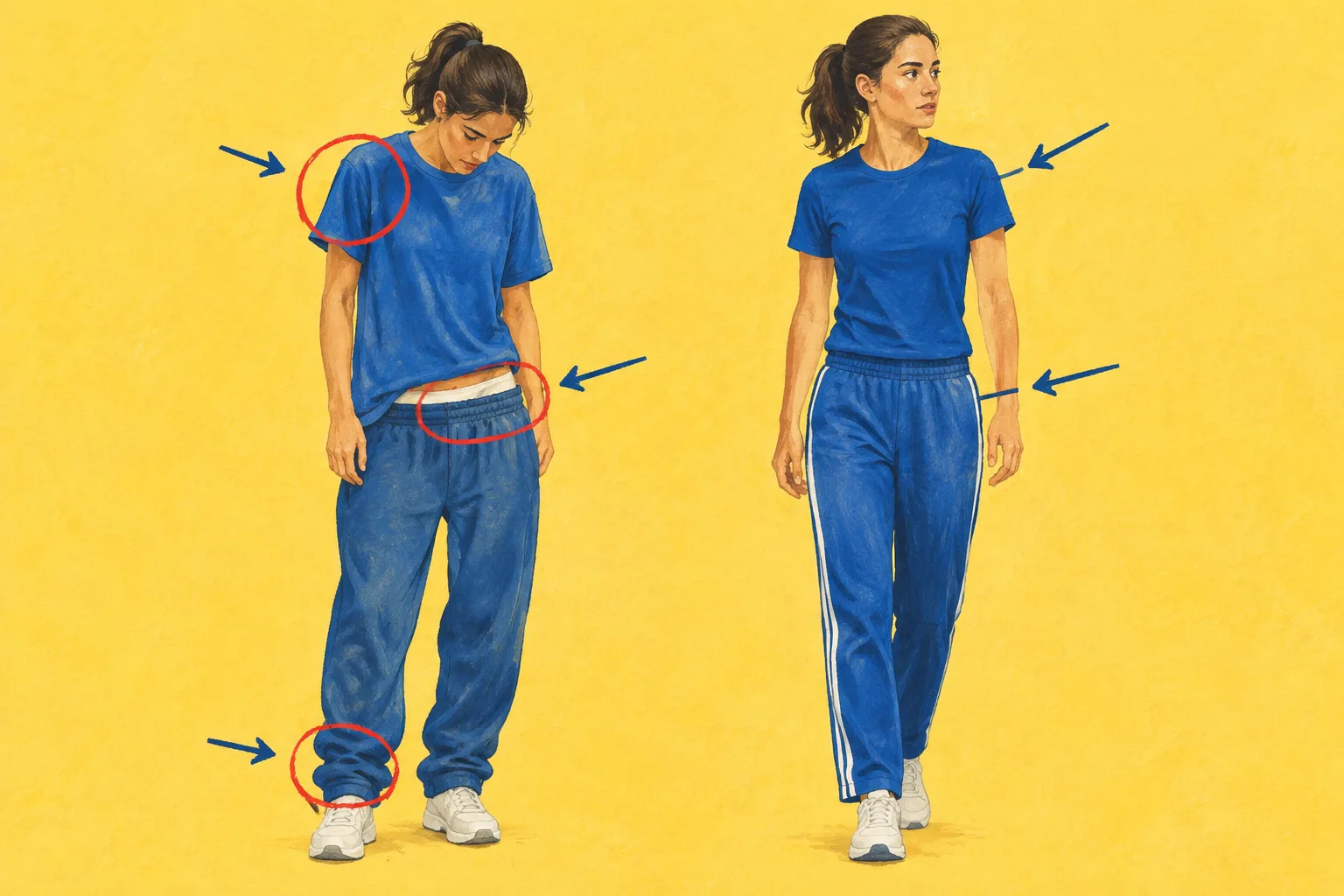
Full-length leggings are cut for a specific inseam, and most brands build them for a taller frame than the average wearer. The result is a stack of fabric folds around the ankle, sometimes dragging over the heel of the sneaker, sometimes pooling inside the shoe. It reads as borrowed clothing. A hem that hits the ankle bone or sits just above it looks deliberate; a hem that gathers in three horizontal folds looks like the wrong size.
Petite cuts help, and so does a brand that publishes its inseam in inches rather than labeling everything "full length." The seven-eighths crop, which ends a couple of inches above the ankle, solves the problem for most heights and looks sharp with a low-profile sneaker. If a favorite pair already puddles, a tailor can take an inch off for a modest fee, and the improvement is immediate.
The Oversized Tee With Nothing Underneath It
A heavyweight cotton tee in a relaxed cut is one of the best pieces in the activewear wardrobe. Worn alone over leggings, though, it tends to hang from the shoulders and create a triangle of fabric that swallows the body and ends somewhere mid-thigh. The proportions go slack, and the outfit loses its waist entirely. The top half looks like sleepwear and the bottom half looks like training gear, and the two halves stop speaking to each other.
Two moves rescue it. A front tuck, where the hem gets gathered and tucked just at the center of the waistband, restores a waistline without losing the ease of the cut. Or the tee gets knotted at one hip, which shortens the line and adds a bit of shape. Both take five seconds and change the whole silhouette.
Sneakers Chosen for the Outfit Instead of the Walk
The chunky retro sneaker has been the default for years, and it has a real place. It does not belong on a long walk to the studio, where its weight and stiffness turn every step into a small negotiation. The visible slip is not the shoe itself; it is the way the wearer moves in it, the careful, slightly flat-footed gait of someone in a shoe chosen for how it photographs.
A running shoe with a modern, low-profile upper reads just as cleanly with leggings and handles a mile on foot without complaint. The styling rule is simple: pick the shoe for the distance, then style around it. When the shoe is correct for the activity, the rest of the outfit tends to settle into place.
Too Many Logos in One Outfit
Activewear is saturated with branding. A sports bra with a chest logo, leggings with a calf logo, a tee with a chest logo, a cap with a front logo, and a sneaker with three. Each piece is fine alone. Together they turn a person into a walking sponsorship deck, and the eye has nowhere to rest. The effect is loud in a way that reads as careless rather than confident.
One visible logo per outfit is a workable ceiling. Let the shoe carry it, or the cap, and keep everything else clean. Unbranded basics are widely available and often cheaper, and they make the one branded piece look intentional rather than accidental.
The Matching Set That Does Not Match the Activity
Matching sets look effortless in photographs and can be genuinely great in the right context. The slip happens when a sculpted, compressive set built for lifting gets worn to a hot yoga class, or a loose, breezy set built for recovery gets worn to a spin class. The fabric is wrong for the sweat, the fit is wrong for the movement, and the wearer spends the session adjusting instead of moving.
The set itself is not the problem. The mismatch is. A compressive set belongs in the weight room; a soft, draped set belongs on the walk home and the coffee run. Wearing the right set to the right place is half of what makes it look put together.
Bags and Layers That Fight the Clothes
A structured leather tote over a soft, draped hoodie creates a clash of textures and weights that makes both pieces look worse. A heavy canvas duffel slung over a light tank drags the neckline sideways. A bulky puffer over fitted leggings can work, but a puffer that ends at the widest part of the hip adds volume exactly where the leggings were trying to streamline.
The bag should look like it could plausibly carry the gear for the activity. A nylon gym sack, a simple canvas tote, a small crossbody for a walk: each one sits comfortably against activewear because it shares its register. The layer, meanwhile, should end above or below the widest point of the hip, not right on it.
The Hair Tie on the Wrist and the Phone in the Waistband
Small habits, visible ones. A hair tie worn around the wrist all day leaves a red mark and reads as unfinished. A phone shoved into the back waistband of leggings stretches the fabric and creates a visible lump that pulls the whole line off-center. Neither is a catastrophe. Both are the kind of detail that separates a person who looks dressed from a person who looks like they are mid-transition between two parts of their day.
A small zippered belt bag or a phone pocket built into the legging solves the second one. The first one solves itself the moment the hair tie goes back in the hair or into the bag. These are the cheapest fixes on the list and among the most visible.
Why the Small Slips Matter More Than the Big Ones
A single styling slip is forgettable. Four of them at once create a category: the outfit that looks like it was assembled in the dark. The good news is that the same logic runs in reverse. Fixing the hem, tucking the tee, swapping the sock, and choosing one logo instead of five takes maybe ten minutes total and moves an outfit from "ran errands in gym clothes" to "wore gym clothes on purpose."
The person who looks sharp in activewear is rarely wearing more expensive gear. They are wearing gear that fits, in a combination that was chosen rather than grabbed. The difference shows up at the ankle, at the waistband, and at the wrist, in the small places where most people stop paying attention.