
Tailored Trousers and Sneakers: A Pairing That Actually Works
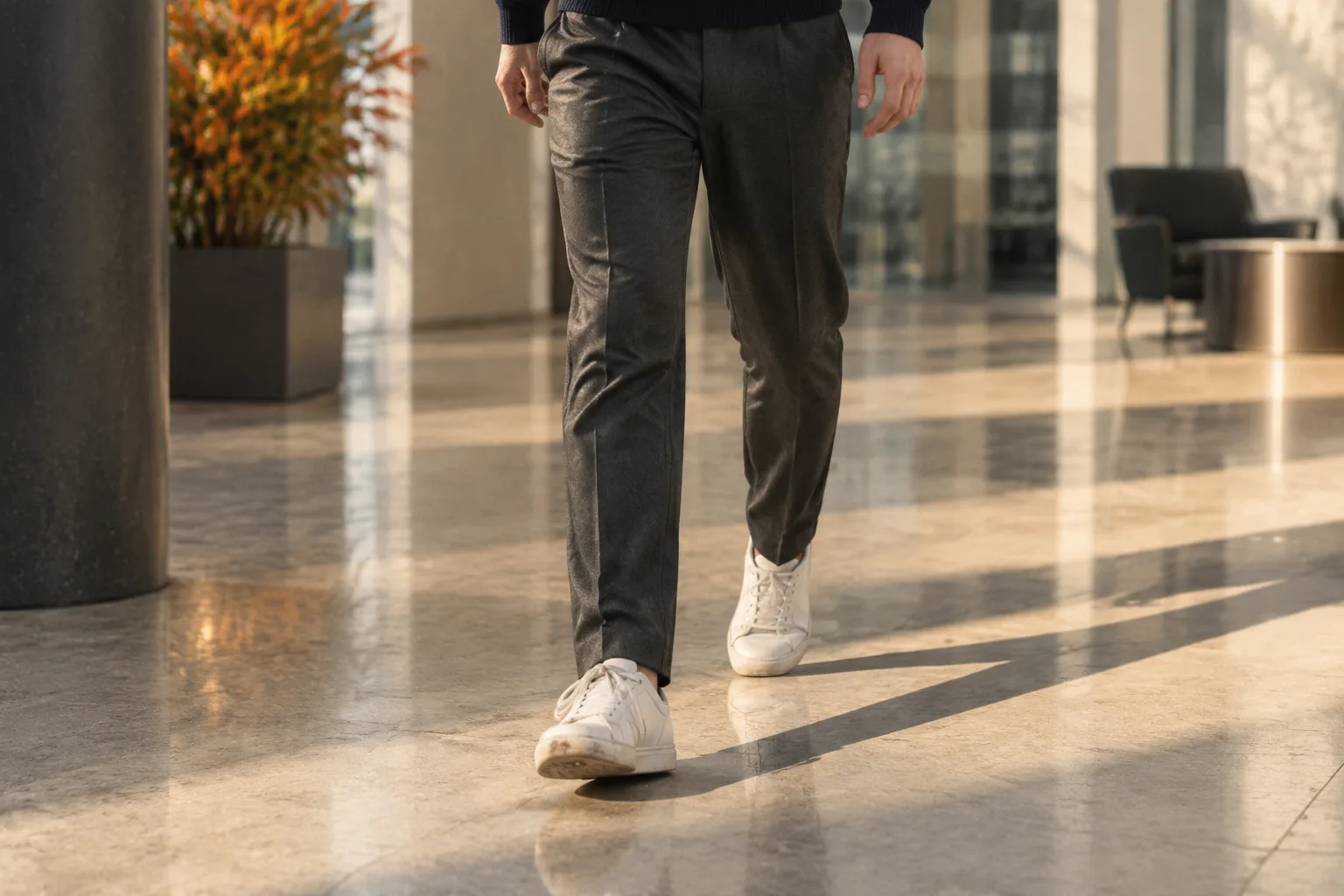
The trousers are charcoal, cut with a clean line from waist to ankle, and the shoes are white leather sneakers with a scuff on the left toe. The combination reads as deliberate the moment it crosses a room. It is also the source of more quiet anxiety than almost any other pairing in a modern wardrobe, because it sits on a fault line: the trouser belongs to the language of tailoring, and the sneaker belongs to the language of the street, and the two have only recently agreed to share a sentence.
That agreement is real. It is also conditional. Tailored trousers and sneakers work together under a specific set of rules, and when those rules are broken the result is not casual elegance but a person who looks like they forgot their real shoes at home. The pairing has become common enough that it is easy to assume it always works. It does not. The difference between a sharp silhouette and a sloppy one comes down to a handful of decisions about proportion, fabric, and the sneaker itself.
The silhouette has to end somewhere clean
The single most important variable is the hem. A tailored trouser that pools over a sneaker looks defeated. The fabric bunches at the ankle, the break swallows the shoe, and the whole line collapses into a pile of cloth sitting on a rubber sole. The fix is a hem that stops just above the shoe, with a slight break or none at all, so the trouser leg and the sneaker meet as two distinct forms rather than one confused mass.
This is where the sneaker's height matters. A low-profile shoe with a thin sole lets the trouser fall almost to the floor and still look intentional, because there is not much shoe to accommodate. A chunky sneaker with a thick sole forces the hem up, and a trouser cut too long for that shoe will drape awkwardly over the collar. The hem and the shoe have to be chosen together. Buying the trousers first and hoping the sneakers fit underneath is how the pairing goes wrong.
There is a useful test. Stand in front of a mirror with the trousers on and the sneakers on. If the fabric touches the top of the shoe and stops, the line is working. If the fabric folds over itself and rests on the shoe, the hem is too long. If there is a visible gap of bare ankle, the hem is too short for most settings, though a cropped cut can carry that look on purpose.
Fabric weight decides whether the look reads as sharp or sloppy
Wool trousers with a crisp hand and a bit of structure hold their line down to the ankle. They make the sneaker look like a choice. Lightweight cotton or linen trousers, especially in a relaxed cut, tend to crumple and sag, and the sneaker then looks like the only pair of shoes the wearer owns. The fabric has to be heavy enough to keep its shape against the casual pull of the shoe.
A mid-weight wool flannel, a cotton twill with some body, or a wool blend with a dry finish all work. Thin summer fabrics can work too, but they need a sharper cut and a cleaner hem to compensate. The point is that the trouser has to look like it was made for something, because the sneaker is already doing the work of relaxing the outfit. If both halves are relaxed, there is nothing left to hold the shape.
Color plays into this more than most people admit. A dark trouser against a white sneaker creates a hard edge at the ankle, and that edge is what makes the pairing look intentional. A pale trouser against a pale sneaker softens the same edge into something blurrier, which can be elegant but is much harder to control. The contrast at the ankle is doing a lot of the visual work.
The sneaker has to be the quiet kind
Not every sneaker belongs under a tailored trouser. The ones that work are low, clean, and free of aggressive branding. A plain leather court shoe, a canvas low-top in a solid color, a minimal runner with a slim sole: these read as footwear that happens to be casual. A high-top basketball shoe, a bulky trail runner, or anything with a visible logo the size of a playing card pulls the eye down and breaks the line.
The condition of the shoe matters as much as the model. A scuffed white sneaker under a wool trouser can look lived-in and confident. A filthy one looks careless. The pairing is asking the sneaker to stand in for a dress shoe, and a dress shoe would never be worn caked in mud. The sneaker does not need to be pristine, but it needs to look maintained.
Sole thickness is the sneaker's version of the hem problem. A thin sole keeps the foot low and the proportion tidy. A thick sole adds height and bulk, which can work with a wider trouser but fights a slim one. The general rule is that the slimmer the trouser, the thinner the sole should be. A wide-leg trouser can carry a chunkier sneaker because the fabric volume balances the shoe volume.
Where the pairing comes from, and why it stuck
The combination has a history that predates its current ubiquity. Designers began sending tailored trousers down runways with sneakers years ago, and the look moved from editorial pages into offices and dinners. The appeal was obvious: it let a person wear the comfort of a sneaker without abandoning the structure of a suit separate. It solved a real problem for people who found dress shoes intolerable but still wanted to look put together.
The look stuck because it is genuinely practical. A person can walk to a meeting, stand for an hour, and take the train home without their feet complaining. That practicality is why it spread beyond fashion and into ordinary wardrobes. But the practicality is also why it gets abused. Once a look becomes normal, people stop paying attention to the details that made it work in the first place.
The waist and the shirt decide the formality
A tailored trouser and a sneaker sit in a middle register, and the top half of the outfit tells the reader which direction to lean. A crisp shirt tucked in with a belt pushes the look toward business casual. A knit polo or a fine-gauge sweater pushes it toward relaxed. A t-shirt under an unstructured blazer keeps it casual but deliberate. The trouser and sneaker stay constant; the shirt is the dial.
The waist matters because the trouser is the structured element. If the trouser sits at the natural waist and is held there by a belt, the outfit has an anchor. If it sags or is worn too low, the whole silhouette drops and the sneaker starts to look like the only casual thing in an otherwise collapsing outfit. The waistband is where the tailoring asserts itself, and the sneaker is only convincing when the tailoring is convincing first.
A belt is optional but useful. It creates a horizontal line that separates the top and bottom and makes the trouser look intentional. Without a belt, a tucked shirt can look unfinished unless the trouser has side adjusters or a clean waistband. The details at the waist are small, but they are what separate a considered outfit from a pair of trousers that happen to be worn with sneakers.
Occasions where the pairing should stay home
There are rooms where a sneaker under a tailored trouser is the wrong answer. A formal wedding, a black-tie dinner, a courtroom, a funeral: these are settings where the dress shoe is part of the dress code, and the sneaker reads as a refusal to participate. The pairing is flexible, but it is not universal. Knowing where it stops is part of wearing it well.
Business settings are a gray area. A creative office may accept the pairing without comment. A conservative one may not. The safe move in an unfamiliar environment is to read the room before committing, or to keep a pair of proper shoes within reach. The look is confident, and confidence in the wrong room becomes a liability.
The socks question, settled by the hem
Socks under a tailored trouser and a sneaker are a practical decision that the hem already answers. If the trouser stops just above the shoe, a no-show sock keeps the ankle clean and the line uninterrupted. If the trouser is cropped higher, a thin sock in a color that matches the trouser can look deliberate. A visible athletic sock with a stripe is a different look entirely, and it belongs to a different outfit.
The exception is cold weather. A fine merino sock in a dark color under a wool trouser and a leather sneaker is comfortable and looks intentional. The rule is that the sock should be thin and quiet, so it reads as a detail rather than a statement. Thick ribbed socks with a tailored trouser and a sneaker create a break at the ankle that fights everything above and below it.
A short list of combinations that hold up
A charcoal wool trouser with a plain white leather low-top and a tucked oxford shirt is the most reliable version. A navy cotton twill trouser with a canvas low-top and a knit polo is the summer version. A stone-colored wide-leg wool trouser with a chunky white sneaker and a loose sweater is the relaxed version. Each of these works because the hem is clean, the fabric has body, and the sneaker is quiet.
The combinations that fail tend to share the same flaws: a hem that pools, a fabric that sags, a sneaker that shouts. Fix those three and most trousers will work with most sneakers. Ignore them and the pairing looks like an accident even when it was carefully planned. The look is forgiving of color and cut, and unforgiving of proportion.
A person who gets the hem right, chooses a trouser with structure, and keeps the sneaker simple can wear the pairing anywhere the dress code allows. The rest is detail. The trouser carries the tailoring, the sneaker carries the comfort, and the ankle is where the two negotiate. That negotiation is the whole look, and it happens in the last two inches of fabric above the shoe.