

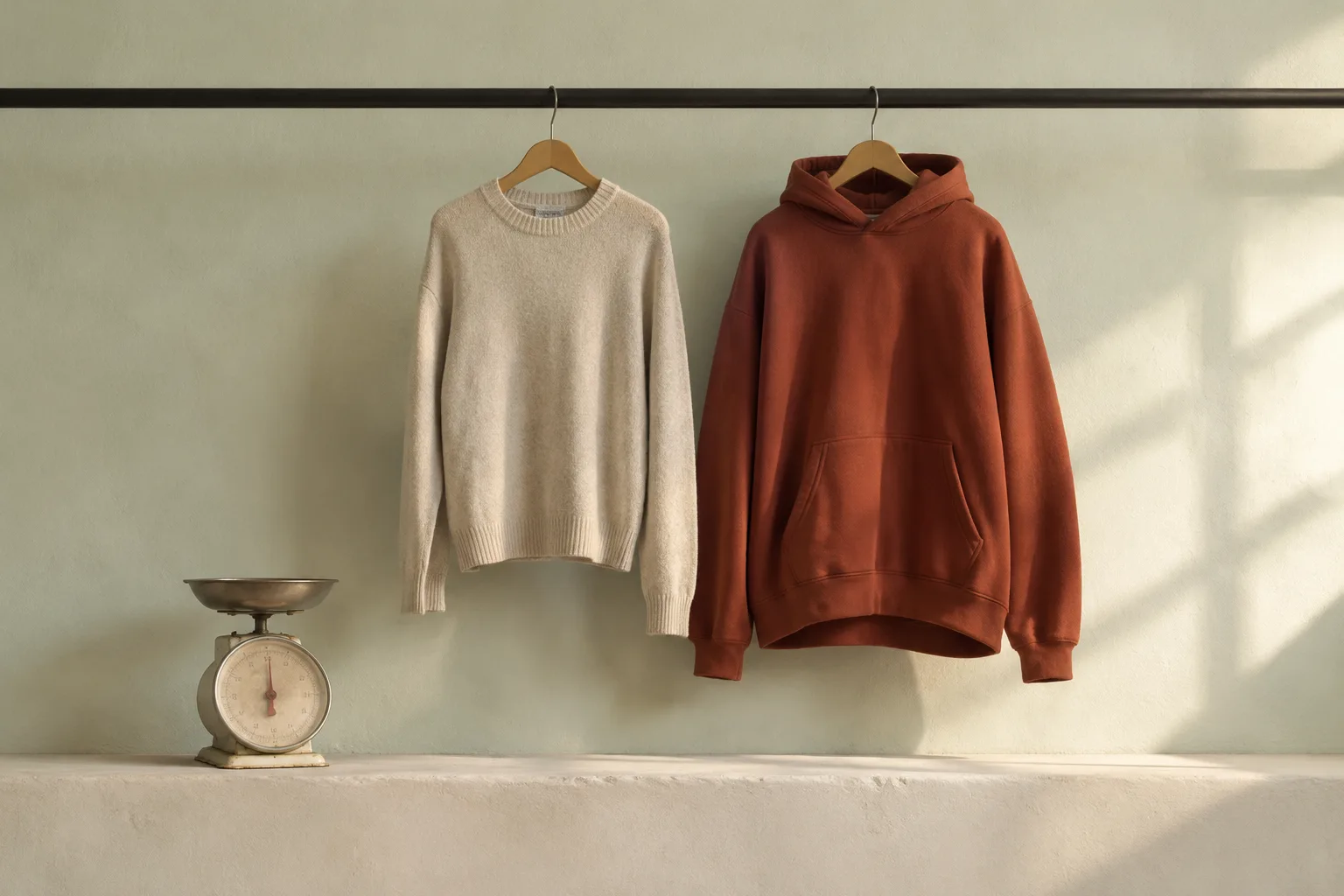
The In-Between Layer: Choosing Lightweight Pieces That Do More
A thin merino crewneck weighs about 150 grams. A heavy cotton hoodie runs closer to 600. Between those two figures sits an entire wardrobe category that most people never name: the in-between layer, the piece light enough to forget and warm enough to matter. It is the garment that lives on the back of a chair, gets stuffed into a tote bag, and quietly rescues a day that started colder or ended later than planned.
The clothing industry has spent enormous energy on the outer layer (the coat, the shell, the parka) and the base layer (the tee, the undershirt, the thermal). The middle has been left to drift. Walk through any store and the midweight category is a jumble of hoodies, quarter-zips, fleece pullovers, and nameless "layering pieces" that all promise versatility and deliver a shelf full of things that are too warm indoors and too thin outdoors.
The problem is weight, and the problem is also cut. A 300-gram fleece worn under a jacket bunches at the elbows. A 120-gram shirt worn alone at 55 degrees leaves the shoulders cold. The useful range is narrower than the marketing suggests, and finding the pieces that actually occupy it takes more attention than most shoppers give.
What "Lightweight" Actually Means in Fabric Terms
Fabric weight is measured in grams per square meter, usually shortened to gsm. A standard cotton T-shirt sits around 150 to 180 gsm. A dress shirt is nearer 120. Heavy flannel can hit 250. The lightweight layer lives between roughly 180 and 280 gsm: heavier than a tee, lighter than a sweater, dense enough to hold shape but thin enough to slide under a coat without a fight.
That range is where merino wool shines, and it is also where good synthetic blends and fine-gauge cotton knits earn their place. A 200 gsm merino crewneck regulates temperature in a way that a 400 gsm lambswool sweater cannot, because the lighter knit lets heat escape before it builds. The heavier sweater keeps a person warm in a cold room; the lighter one keeps a person comfortable across a range of rooms.
Knitters talk about gauge the way printers talk about paper stock. A fine-gauge knit, usually 12 to 14 stitches per inch, produces a flat, smooth surface that layers cleanly. A chunky gauge, 5 or 6 stitches per inch, produces bulk. For the in-between role, fine gauge wins almost every time, because the whole point is to add warmth without adding silhouette.
The Quarter-Zip That Earns Its Hanger Space
Of all the shapes in this category, the quarter-zip pullover has the strongest case, and the case rests on one mechanical detail: the zipper. A full-zip cardigan opens too far and flaps. A crewneck cannot vent. A quarter-zip, opened four or five inches at the collar, dumps heat in about ninety seconds without coming off. That single adjustment covers the difference between a heated office and a cold platform.
The good ones are made from a fine-gauge merino or a merino-synthetic blend, cut close through the torso with a slightly longer body so the hem stays put when seated. The bad ones are cut boxy and made from a polyester fleece that pills after a season. The difference is visible at the shoulder seam: a well-made quarter-zip has a seam that follows the arm's natural curve; a cheap one runs straight across and pulls whenever the arm lifts.
Navy, charcoal, oatmeal, and a deep olive cover nearly every use case. A bright color in this layer is a mistake, because the piece is meant to disappear under a jacket and read as neutral when worn alone. The in-between layer is a supporting actor. It should never compete with the coat.
Why the Cardigan Deserves a Second Look
The cardigan carries a reputation problem, mostly inherited from boxy, ribbed versions worn by television grandfathers. The modern lightweight cardigan, in a fine-gauge merino or a cotton-cashmere blend, is a different garment. Worn open over a tee, it handles the 60-to-68-degree range that defeats both a sweater and a shirt. Buttoned under a coat, it adds a collar line without bulk.
The advantage over a pullover is control. A cardigan can be fully open, half-buttoned, or closed, which gives three distinct warmth levels from one piece. The disadvantage is drape: an open cardigan moves, and a poorly cut one swings away from the body at the hem. Look for a slightly cropped body and a ribbed hem that sits at the hip bone. Anything longer starts to read as a bathrobe.
Wearing one under a blazer takes a little nerve and rewards it. A thin cardigan under an unstructured blazer adds a soft layer of warmth and a visible collar that reads as deliberate. The trick is keeping both pieces close to the body; a loose cardigan under a structured jacket creates a lump at the chest that no amount of adjusting fixes.
The Vest, Which Is Not a Fashion Crime
A lightweight knit vest, worn over a shirt or a tee, solves a problem no other piece addresses: keeping the torso warm while leaving the arms completely free. For anyone who runs warm from the elbows down, or who works at a desk where a full sleeve catches on the keyboard, the vest is the most efficient layer in the closet.
The perception problem is real. The vest spent two decades associated with finance and golf, and the association stuck. The version that works today is cut slightly oversized, in a soft merino or a cotton blend, with a deep V or a crew neck. Worn over a white tee with trousers, it looks intentional. Worn over a dress shirt with a tie, it looks like a costume. The difference is entirely in what sits underneath.
Cotton, Merino, and the Case Against Heavy Fleece
Fleece is the default midlayer for a reason: it is cheap, it is warm, and it survives the washing machine. It is also the worst choice for the in-between role, because polyester fleece traps heat and does not breathe. A 300 gsm fleece worn indoors becomes a sauna within twenty minutes. The same fleece worn outdoors under a shell becomes clammy the moment the walking stops.
Merino handles the temperature swing. The fiber absorbs moisture and releases it slowly, so a person who walks ten minutes to a train and then sits for thirty does not arrive damp. It also resists odor, which matters for a layer worn several days in a row. The drawback is price and care: a good merino quarter-zip runs north of a hundred dollars and will felt in a hot wash. A mesh bag and cold water solve the second problem.
Fine-gauge cotton is the affordable middle path. It breathes, it drapes well, and it can be machine washed without ceremony. It lacks merino's warmth-to-weight ratio and its odor resistance, but for a layer worn indoors more than out, cotton does the job. A cotton-cashmere blend, usually 90 percent cotton and 10 percent cashmere, adds softness without much cost.
Fit Rules That Apply to Every Piece in This Layer
The in-between layer has one fit requirement that overrides everything else: it must sit close enough to slide under a jacket without bunching at the armpits. That means a shoulder seam that lands on the shoulder bone, a sleeve that ends at the wrist bone, and a body that skims rather than hugs. A layer with two inches of extra room in the chest will bunch the moment a coat goes over it.
The hem matters more than most people realize. A hem that ends mid-hip tucks cleanly into trousers. A hem that ends at the belt line rides up when seated. A hem that ends low on the thigh reads as a tunic and belongs in a different conversation. For a piece meant to be worn alone as often as under something, mid-hip is the safest length.
A Rotation of Three, Not a Drawer of Fifteen
The practical version of this category is small. One fine-gauge merino quarter-zip in a dark neutral. One lightweight cardigan in a mid-tone. One knit vest, if the wearer runs warm. Those three pieces cover the shoulder seasons, the cold office, the over-air-conditioned restaurant, the flight, and the evening that turns colder than the afternoon forecast promised.
The reason to keep the rotation small is that the in-between layer fails when it accumulates. A drawer full of midweight pieces means every morning becomes a decision between six garments that all do the same thing slightly differently. Three pieces, each with a clear role and a clear temperature range, removes the decision entirely. The quarter-zip goes on when the day starts at 50 and ends at 65. The cardigan goes on when the day stays in the 60s. The vest goes on when the arms need to stay free.
The wardrobe's most useful garment is the one that gets worn without being noticed. A coat announces itself. A shirt shows its pattern. The layer in between does its work in the gap, adding just enough warmth to keep a day from being cut short, and disappearing into the outfit so completely that the wearer forgets it is there until the moment it is needed. That is the whole job, and the pieces that do it well are worth the search.