

The Quarter Zip, Dressed Up and Dressed Down
A quarter zip, at its plainest, is a collarless knit pullover with a short metal zipper running from the neck to the chest. That is the whole garment. No buttons, no lapels, no placket down the front. The zipper ends a few inches below the collarbone and the rest is a continuous tube of wool, cotton, or fleece. Most sit in a drawer for eleven months and get pulled out for the same three occasions: a cool morning, a flight, a Sunday errand. The garment deserves better than that.
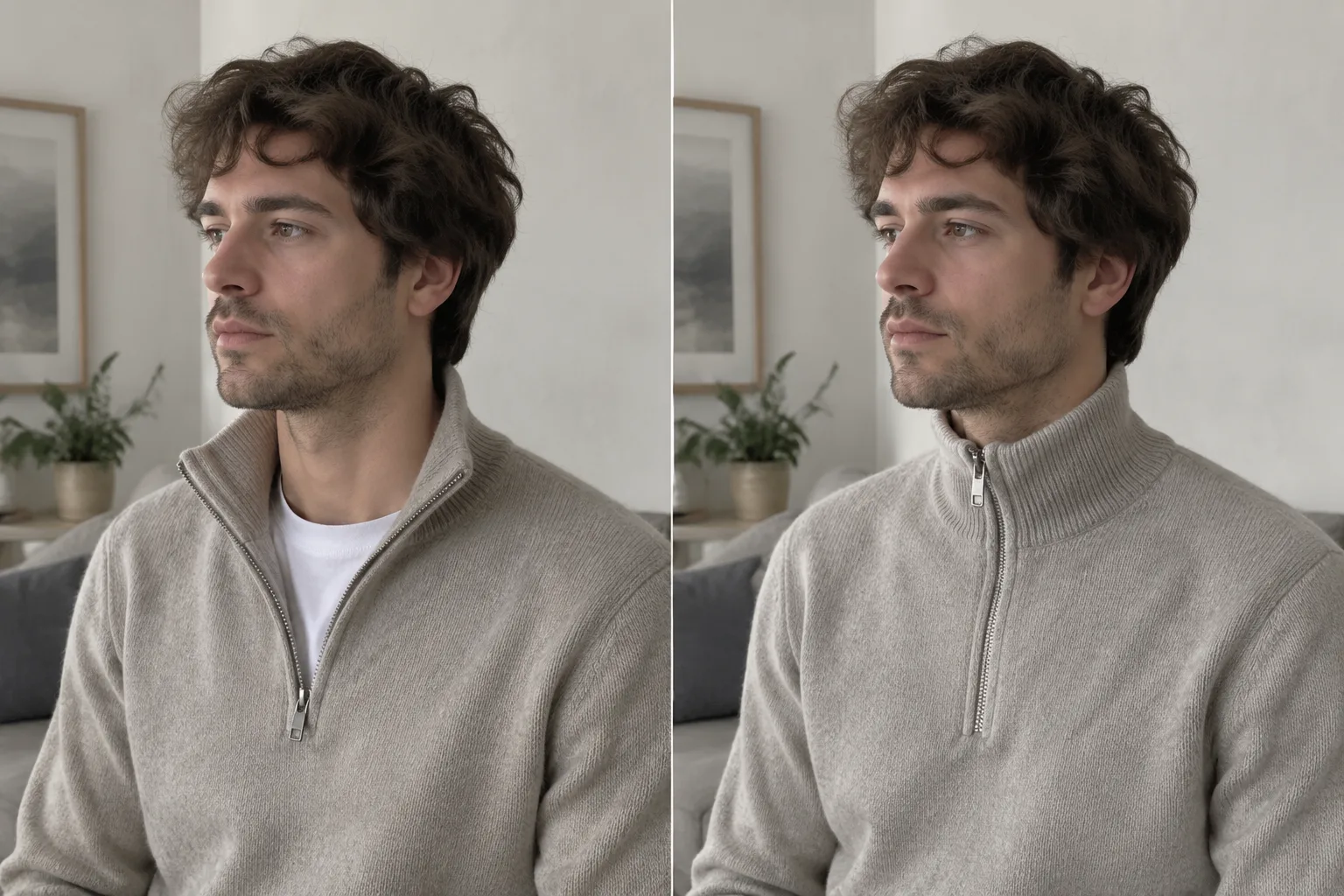
What makes it interesting is its refusal to commit. Open the zip to the sternum and it reads as a layer over a t-shirt, casual, almost sloppy. Close it to the chin and it becomes something approaching formal, a clean column of knit under a jacket. The same piece of clothing, two different social registers, one zipper pull. Very few garments offer that range, and almost nobody uses it.
Zipping Up Under a Blazer
The dressed-up version is the one people get wrong most often. The instinct is to treat the quarter zip as a substitute for a dress shirt, which it is not. It is thinner, softer, and lacks a collar to anchor the neckline of a jacket. Worn under a tailored blazer with nothing beneath it, the result can look like a man who forgot the rest of his outfit. The knit hugs the torso, the jacket floats over it, and the gap at the collar reads as an accident.
The fix is counterintuitive: put something under it. A plain white crew-neck t-shirt, thin and close to the body, gives the quarter zip a base to sit on. Then zip it to just below the collarbone so the white collar peeks out at the neck. The layers stack cleanly, the jacket has something to work with, and the whole arrangement looks deliberate rather than improvised.
Color does most of the heavy lifting here. A navy or charcoal quarter zip in a fine merino or a smooth cotton-cashmere blend sits comfortably under a grey or brown blazer. A bright color, a mustard or a rust, fights the jacket and drags the outfit toward casual. The dressed-up quarter zip is quiet. It is meant to disappear into the silhouette and let the tailoring lead.
Texture matters more than most people realize. A ribbed or cable-knit quarter zip is too chunky to layer under a structured jacket; the bulk pushes the blazer out at the chest and the shoulders go lumpy. A flat, fine-gauge knit, around 12 to 14 gauge for the knitters in the room, slides under tailoring without adding visible mass. The zipper should be small and metal, ideally with a pull tab slender enough to disappear under the jacket's lapel. A chunky plastic zipper on a dressy quarter zip is a small betrayal that the eye catches.
The Collar Problem in Formal Settings
There is one structural issue with the dressed-up quarter zip that no amount of layering fully solves: the neck. A dress shirt has a collar that frames the face and creates a clean line against the jacket lapel. A quarter zip, even zipped high, leaves the neck exposed in a soft, rounded way. In a business setting where everyone else is in collared shirts, the quarter zip reads as one notch less formal, no matter how expensive the knit.
That notch is fine in most offices, especially in the cooler months and especially in industries where a full suit would look absurd. In a room full of men in spread-collar shirts and silk ties, though, the quarter zip is the odd one out. It belongs to a business-casual register that has largely replaced the tie in the last decade. The garment has ridden that shift well. It looks modern where a shirt and tie look stiff, and it carries just enough structure to pass in a meeting.
The trick to wearing it formally is to keep everything else sharp. Pressed trousers, leather shoes, a jacket that fits at the shoulders. The quarter zip then becomes the soft note in a hard outfit. If the rest of the look is sloppy, the quarter zip takes the blame.
Open Zip, Weekend Mode
Dressed down, the quarter zip is easier and more forgiving. Zip it open to the chest and wear it over a t-shirt, or over nothing at all on a warm day. Pair it with jeans, chinos, even shorts if the knit is light enough. This is the version most people already own and already wear, and it works because the open zip breaks up the torso and keeps the silhouette from looking like a sweater with a neck problem.
The relaxed version lives or dies on fit. A quarter zip that is too loose hangs off the shoulders and bunches at the waist, and the open zip makes the excess fabric obvious. A quarter zip that is too tight strains across the chest when zipped and clings when open. The right fit sits close to the body without pulling, ends at the hip bone, and leaves enough room to layer a t-shirt underneath without visible bunching at the shoulders.
Fabric choice matters here too, in a different direction. A heavier fleece or a thick lambswool is the weekend workhorse: warm, forgiving, and sturdy enough to survive a hike or a school pickup. A fine merino is the travel piece, thin enough to pack flat and warm enough for a cold cabin. The two versions serve different lives, and owning one of each covers most of the year.
The Zipper as a Volume Knob
Think of the zipper as a dial that controls how much the outfit says. Fully closed, the quarter zip is a closed system: neat, contained, almost austere. Fully open, it is a frame around whatever is underneath, a chance to show a t-shirt graphic or a striped shirt or a plain white tee. Half zipped, it lands somewhere in between, and that middle position is where the garment does its best work.
The half-zip position also fixes a small proportion problem. A quarter zip worn fully closed has a high, tight neckline that can make the wearer look compressed, especially if the torso is short. Leaving the zip down an inch or two opens the chest and lengthens the line of the body. It is a small adjustment with an outsized effect, the kind of thing that separates a person who looks comfortable in the garment from one who looks like they borrowed it.
There is a practical limit. Zipping all the way up on a warm day traps heat at the neck and looks tense. Zipping all the way down on a cold day defeats the purpose. The garment rewards a wearer who reads the temperature and adjusts, the way a driver reads a road.
What to Wear It With, Specifically
The dressed-up formula, spelled out: a fine-gauge merino quarter zip in navy, charcoal, or oatmeal, zipped to the sternum, over a white crew-neck tee, under a soft-shouldered blazer in grey or brown, with wool trousers and leather derbies. A leather watch, no tie, no pocket square. The outfit works for a dinner, a client meeting in a creative office, a wedding where the invitation says cocktail but the groom is wearing sneakers.
The dressed-down formula: a heavier cotton or fleece quarter zip in a color that can take a stain, zipped halfway, over a plain t-shirt, with dark jeans and clean sneakers. A canvas jacket over the top if it is cold. This is the outfit for a Saturday market, a long drive, a casual lunch where nobody is checking. The quarter zip does not need to be expensive here. It needs to fit and it needs to be clean.
The in-between formula, which is the one most people actually need: a mid-weight knit quarter zip, zipped just below the collarbone, over a collared shirt with the collar left open, with chinos and loafers. No jacket. This is the uniform of the modern office, the school event, the dinner that is nice but not formal. It is the quarter zip's natural habitat, and the garment fills it better than almost anything else in the closet.
The One Thing That Ruins the Look
A quarter zip with a logo across the chest is a different garment entirely. The embroidered patch or screen-printed word turns the piece into a uniform, a company giveaway, a team kit. That is fine for a company retreat or a golf outing with colleagues. It is not fine for anything that requires dressing up. The logo sits exactly where the eye lands first, and it announces that the wearer is wearing something issued rather than chosen.
If the only quarter zip in the closet has a logo, the dressed-up version is off the table. The dressed-down version still works, because the weekend can absorb a logo without comment. For the under-blazer look, a plain knit is the requirement. Small tonal embroidery, a tiny mark on the chest, can pass. A large contrasting logo cannot.
The Case for Owning Two
One quarter zip cannot do everything. The fine merino that slips under a blazer is too delicate for a hike and too warm for a summer evening. The heavy fleece that handles the weekend is too bulky for tailoring. The garment's range is real, but it is range within a type, and the two types serve different halves of a life.
Two is the number: one fine-gauge and neutral for the dressed-up half, one heavier and rougher for the dressed-down half. Between them, the drawer that once held a single sad pullover becomes a small system. The blazer gets a soft layer underneath it. The jeans get a warm layer on top. The zipper does the rest.