

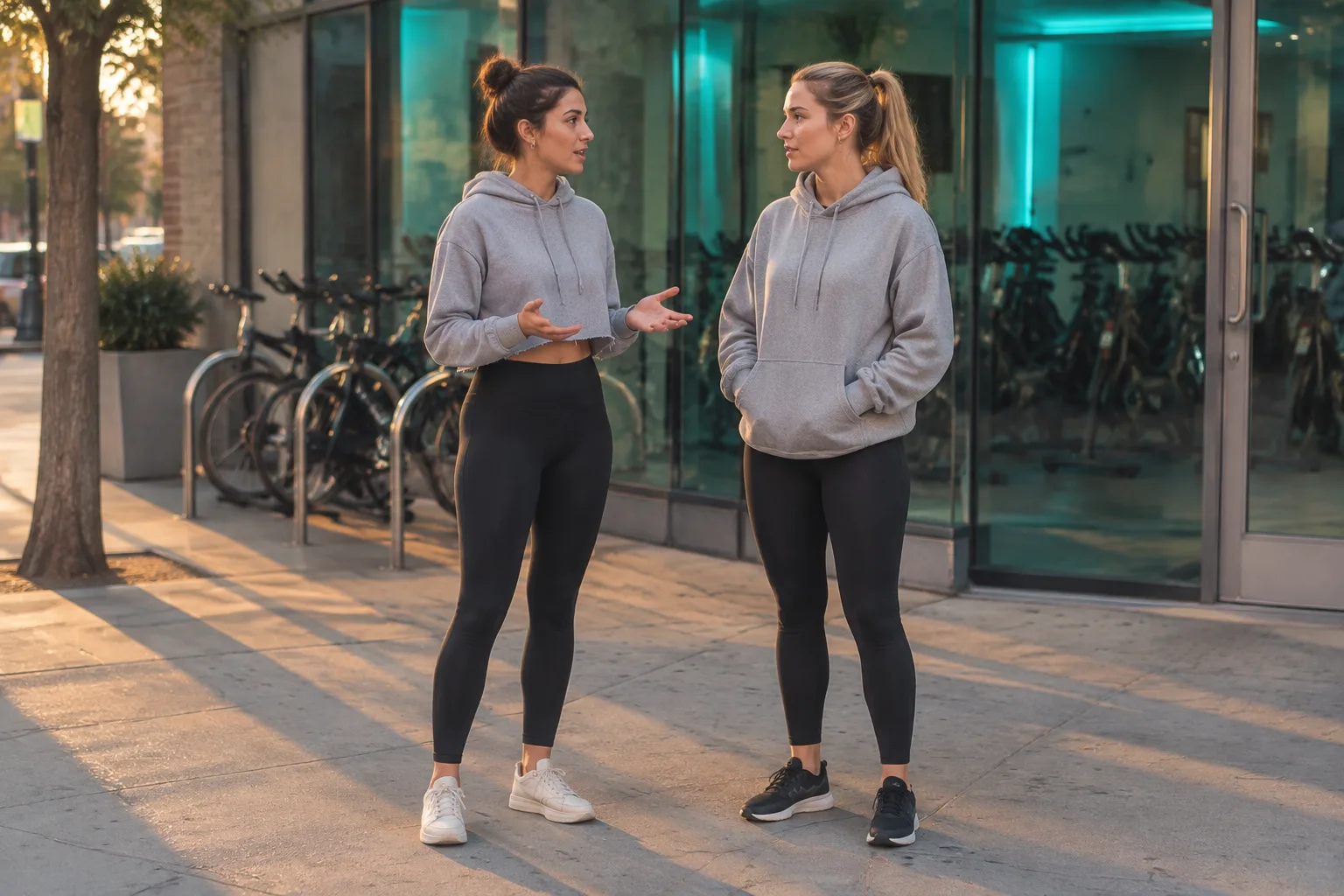
The Quiet Rules That Make Activewear Look Intentional
Activewear has a tell. Two people can wear nearly the same leggings and hoodie combination, and one looks like she just left a spin class on purpose, while the other looks like she got dressed in the dark and gave up. The garments are often almost identical. The difference lives in a set of small, mostly unspoken decisions: proportions, tonal relationships, the way a hem breaks, the choice of shoe. None of these rules are written down anywhere, which is why they feel like intuition when someone gets them right and invisible when someone gets them wrong.
The activewear category has spent a decade convincing people that the clothes themselves do the work. Buy the right legging and the outfit assembles itself. That has never been quite true. A shelf full of expensive pieces can still produce a look that reads as errands. The rules below are the ones that separate the two outcomes, and most of them have nothing to do with what the label says.
The leg line is doing most of the heavy lifting
Watch the ankles. A legging that ends at the widest part of the calf cuts the leg off at its most awkward point and makes the whole silhouette look shorter and softer than it is. A hem that lands just above the ankle bone, or a full-length pair that pools slightly over the shoe, keeps the eye moving down. That single inch of hem placement changes the proportion of the entire body.
This is why cropped joggers are so much harder to pull off than they look on the model. The crop has to land in a spot that feels deliberate, and most of them do not. When in doubt, the full-length version is the safer bet. A person can always push a cuff up. Pulling a hem down is not an option, and a legging that is genuinely too short will never stop announcing itself.
There is a related rule about tightness. A legging that fits like a second skin reads as athletic. A legging that grabs at the waistband and leaves a soft fold above it reads as uncomfortable, and discomfort is the one thing activewear cannot hide. The waistband should sit flat and hold without biting. If it digs, the outfit has already lost.
Fabric weight decides whether the outfit looks cheap
Thin, shiny fabric is the enemy. It catches every light source, shows every seam underneath, and clings in a way that flatters almost nobody. Heavy, matte fabric absorbs light and holds its shape, which is the entire visual difference between a pair of leggings that looks considered and a pair that looks like packaging.
The same logic applies to the top. A thin polyester tee under a jacket will show the jacket's seams through it and create a fussy, lumpy line across the chest. A slightly heavier cotton-blend shirt, even in the same color, sits clean. The fabric does not need to be expensive. It needs to have enough body that it does not outline everything beneath it.
Texture matters here too. Two matte pieces in the same color family read as one continuous surface, which is what gives monochrome activewear its polished look. Mix a matte legging with a shiny jacket and the eye separates the outfit into parts. That separation is fine when it is intentional, but most of the time it just looks like two things were grabbed from the same drawer.
The shoe sets the register of the whole outfit
A running shoe with a thick, sculpted sole and a bright color reads as performance. The same outfit with a flat, minimal sneaker reads as athleisure, closer to streetwear. Neither is wrong, but mixing the two registers is where outfits fall apart. A technical running shoe under a soft, relaxed jogger looks like a mismatch of intent, as if the person could not decide whether they were going for a run or going for coffee.
The cleanest solution is to pick a lane and stay in it. Performance clothing wants a performance shoe: something with structure, a visible midsole, and a color that either matches the outfit or is clearly meant to be the loudest thing in it. Soft, drapey activewear wants a low-profile sneaker, ideally in a neutral that lets the clothing be the story.
The sock is the detail almost everyone forgets. A white crew sock pulled up over a black legging creates a hard line at the ankle and breaks the vertical line the outfit was building. A no-show sock keeps the line clean. A crew sock in the same tone as the legging extends it. Small thing, large effect.
Layering needs one piece with structure
Activewear layering fails when every piece is soft. A thin tee, a soft hoodie, a pair of leggings, all in similar weights, produce a look with no architecture. The eye has nothing to grab onto. The fix is to put one structured piece into the stack: a fitted jacket with a defined shoulder, a vest with a crisp zip, a cap with a firm brim. That single element gives the rest of the outfit a frame.
The jacket is usually the easiest place to add it. A cropped, slightly boxy zip-up over a fitted top and legging creates a clear silhouette: narrow at the waist, wider at the shoulder, cropped at the hip. That shape is flattering on nearly every body type, and it is the shape most activewear brands are quietly copying in their lookbooks.
Length is the key variable. A jacket that ends at the hip bone splits the body in half. The same jacket cropped two inches higher, or dropped two inches lower, reads as intentional. The most reliable proportion is a jacket that ends just above the widest part of the hip, which keeps the leg line long and the torso looking compact.
Color wants a clear hierarchy
Monochrome works, but only when the tones are close enough to read as a family. Black on black is the easiest version. A deep navy legging with a slightly lighter navy top and a gray jacket reads as a coordinated outfit. A navy legging with a black top and a gray jacket reads as three unrelated items that happen to be in the same laundry pile.
The other reliable approach is a neutral base with one strong accent. Charcoal legging, gray top, and a single saturated layer, whether that is a jacket or a shoe, gives the eye a place to land without turning the outfit into a costume. Two accents is usually one too many. Three is chaos.
The color of the accent matters less than its placement. A bright jacket frames the face. A bright shoe grounds the outfit. A bright legging draws the eye to the widest part of the body, which is rarely the goal. When the accent sits at the top or the bottom, the outfit reads as designed. When it sits in the middle, it reads as accidental.
The waistband is a seam, and seams need to sit flat
Activewear tops and bottoms meet at the waist, and that meeting point is where most outfits quietly fail. A top that ends exactly at the waistband creates a visible horizontal line across the middle of the body. A top that ends a few inches below it, or a few inches above it, avoids that line. The crop top over a high-waist legging works because the crop ends above the waistband and leaves a clean band of fabric, not because the crop itself is special.
Tucking is the other tool. A relaxed tee tucked into a high-waist legging, with a little blousing at the waist, gives the outfit a defined waist without the tightness of a fitted top. That small tuck is one of the most underused moves in casual activewear, and it costs nothing.
Wrinkles and pilling read louder than logos
A pristine outfit and a wrinkled one are separated by five minutes and a steamer. The fabric in activewear is often thin enough that a single crease across the thigh or a fold at the knee is visible from across the room. People notice the wrinkle long before they notice the brand. A quick pass with a hand steamer, or a few minutes in a warm dryer with a damp towel, resets the surface.
Pilling is the slower version of the same problem. A legging that has been through two years of washing develops small fuzz balls along the inner thigh and the seat, and that texture makes even an expensive piece look tired. A fabric shaver costs less than a coffee and extends the life of the garment by a year. This is the least glamorous rule on the list, and it is the one that separates people who look polished from people who look like they are wearing their gym clothes to the grocery store.
The gym bag is part of the outfit
Watch what gets carried. A bulky, sagging duffel with a broken strap undermines an otherwise clean look before the person has taken three steps. A structured tote, a small crossbody, or a slim backpack in a neutral tone reads as part of the same decision-making process as the clothing. The bag is the accessory that activewear outfits rarely plan for, and it is the one that shows up in every photograph.
The rule is the same as the one for jackets: one structured element. If the clothing is soft and drapey, the bag can carry the structure. If the clothing is already sharp and fitted, a softer bag balances it. Either way, the bag should look like it was chosen. A canvas tote with a firm base and a single color does more for an activewear outfit than a logo-covered gym sack ever will.
None of these rules are complicated, and that is the point. They are the small, quiet adjustments that make a person look like she meant it. The clothing is the raw material. The intention is the outfit, and intention is built one hem, one seam, one sock at a time.