

The Sock Length That Flatters Low Sneakers
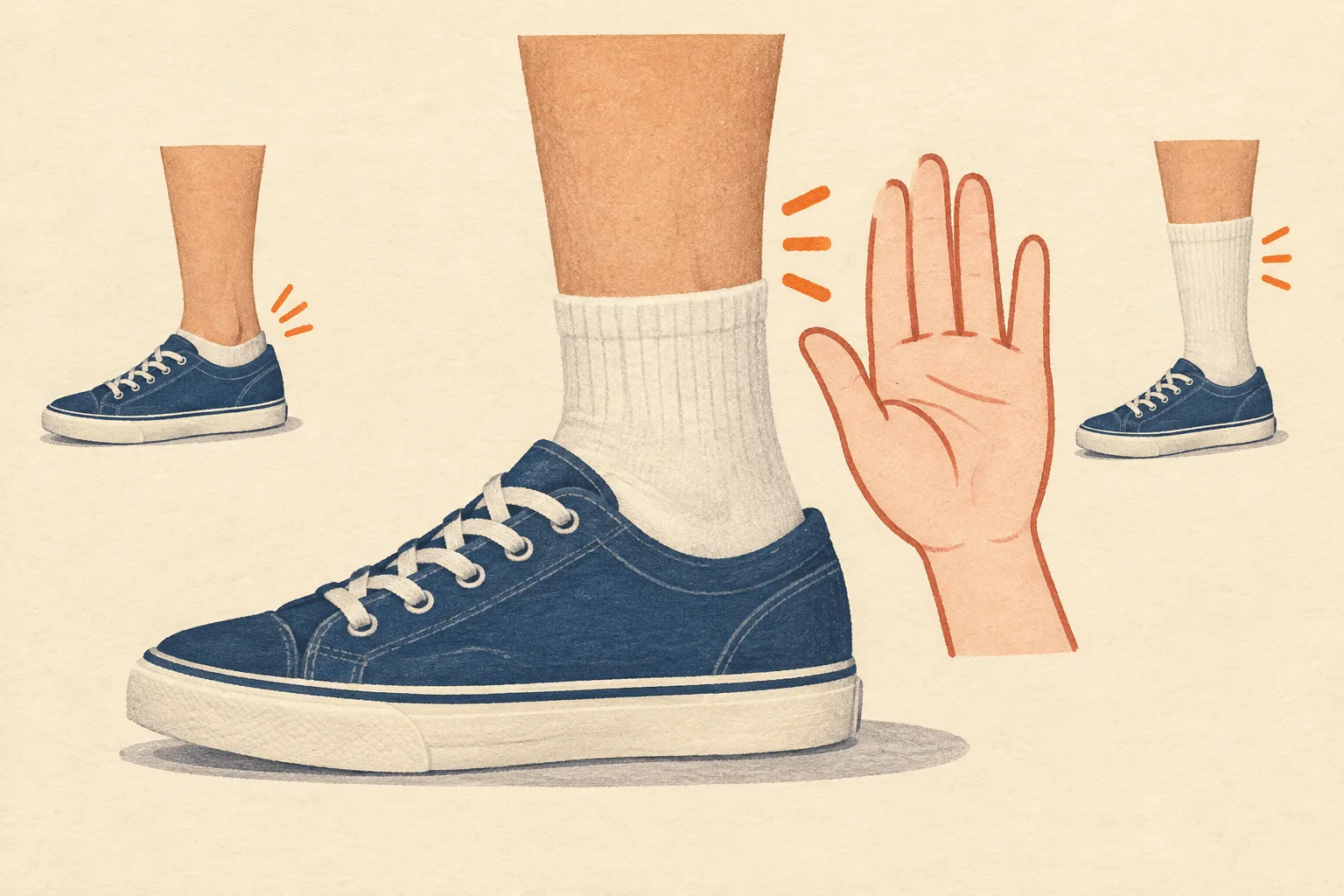
The ankle bone is the problem. A low sneaker cuts a line across the foot just below the malleolus, and everything visible above that line becomes part of the shoe's silhouette. A no-show sock leaves a bare strip of skin that makes the sneaker look like it is floating, unanchored, a little unfinished. A crew sock swallows the ankle whole and turns a lean canvas shoe into a boot. The length that flatters sits in the narrow band between those two failures, and it is shorter than most people wear and longer than most people think.
Call it the quarter sock, or the low crew, or the mid. The names are a mess. What matters is the measurement: a sock that rises two to four finger-widths above the top edge of the shoe, finishing somewhere between the ankle bone and the lower calf. This is the height that gives a low sneaker a visible collar, a deliberate break between shoe and leg, without dragging the eye upward into territory the shoe was never designed to enter.
Why the ankle bone sets the limit
A low sneaker's whole appeal is its cut. The vamp is shallow, the collar dips at the sides, and the shoe exposes the top of the foot and the front of the ankle. That exposure is the design. Any sock decision either respects the cut or fights it.
The malleolus, that bony knob on the outside of the ankle, sits at roughly the same height as the shoe's collar on most low-profile sneakers. A sock that stops below it leaves the bone bare and the shoe looking orphaned. A sock that stops just above it covers the bone and gives the collar a partner. A sock that climbs well past it starts to read as athletic, as if a run were about to happen.
The quarter sock lands in that middle zone. Two to four finger-widths is not a precise measurement, but precision is not the point. The point is a sock that shows, and shows just enough.
The bare ankle is not as clean as it looks
No-show socks have their defenders, and the argument is usually about minimalism: let the shoe be the shoe, let the ankle be the ankle. In photographs from the front, the effect can be sharp. From the side, it rarely is. The bare strip between shoe collar and leg creates a gap that the eye reads as a missing piece, and the sneaker loses the visual weight it needs to sit properly under a hem.
There is also the practical matter of the sock itself. A no-show sock that stays put is a small engineering miracle, and many do not stay put. They slide under the heel, bunch at the arch, and require a discreet adjustment mid-stride that nobody wants to perform in public. The quarter sock has no such problem because it has somewhere to be.
The bare-ankle look does have one genuine home: warm weather, cropped trousers, a deliberately bare-legged outfit. Even then, the quarter sock often improves it, because the sock color can echo the trouser or the shoe and tie the whole assembly together. A flash of ribbed cotton at the ankle is a small, deliberate detail. A flash of bare skin is just skin.
Where the crew sock goes wrong
The opposite error is louder. A standard crew sock, the kind that reaches mid-calf, pairs with a low sneaker the way a turtleneck pairs with a tank top: technically both are clothing, but they belong to different outfits. The crew sock visually extends the shoe upward, filling in the space between collar and calf, and the result is a sneaker that looks taller and heavier than it is.
This is why the low sneaker plus crew sock combination reads as either retro-athletic or accidental. On a basketball court in 1985 it was correct. On a city street with tapered trousers, it usually looks like the wearer grabbed the first sock in the drawer. The shoe's proportions were drawn for a low collar, and a tall sock overwrites them.
There is a narrow exception for very deliberate styling: a thick white crew pushed down to slouch, worn with shorts and a vintage sneaker, is a known look. But that is a costume with rules, and it is not the everyday pairing this piece is about. For ordinary wear, the crew is too much sock for too little shoe.
The two-to-four finger rule in practice
Stand in the shoes. Look at the outside of the ankle. The top of the sock should sit above the ankle bone by roughly the width of two fingers, and it should not climb past four. On a person of average height, that is a sock height of about three to five inches from the sole, though sock sizing varies enough that the finger check is more reliable than the tape measure.
The check works because it scales with the body. A tall wearer with long shins needs a slightly taller sock to hit the same visual proportion; a shorter wearer needs less. The ankle bone is the fixed landmark, and the fingers measure the margin above it.
One adjustment matters: the sock should not bunch at the top. A quarter sock that is slightly too long will fold over itself and create a lumpy ring just above the shoe, which defeats the purpose. The top band should lie flat against the leg, with maybe a half-inch of ease and no more.
Collar height changes the sock height
Not all low sneakers are equally low. A canvas plimsoll with a thin sole and a shallow collar sits differently from a leather court shoe with a padded collar that rises a half-inch higher. The sock has to answer to the shoe.
With a very shallow collar, the quarter sock should be on the shorter end of the range, just clearing the ankle bone. With a padded or slightly higher collar, the sock can go a little taller, because the shoe is already doing some of the visual work. The goal is always the same: a visible band of sock that reads as intentional, not a gap and not a wall.
Slip-on sneakers complicate this further. Their collars are often cut lower at the sides and higher at the heel, and a sock that looks right from the front can look wrong from the back. Try the pair on and check the profile from both directions before committing.
Color decides whether the height reads at all
A quarter sock in the same color as the sneaker makes the shoe look taller and the leg look longer, because the eye reads sock and shoe as one continuous shape. A quarter sock in the same color as the trouser makes the leg look longer instead, because the sock disappears into the hem and the shoe sits alone at the bottom. Both work. They produce different silhouettes.
A contrasting sock, white against a dark shoe or a bright color against a neutral, turns the sock into a deliberate accessory. This is the highest-risk option and the most rewarding when it lands, because it announces that the sock height was a choice. The failure mode is a contrast that looks accidental, which usually means the sock is the wrong height rather than the wrong color.
The safe default for most outfits is a sock that matches either the shoe or the trouser, in a mid-tone that does not call attention to itself. Save the contrast for days when the rest of the outfit is quiet enough to carry it.
Fabric and the visible top band
Because the top of the sock is visible, its texture matters. A thin, smooth dress sock in a quarter height looks odd above a canvas sneaker, too formal and too flat. A thick, ribbed athletic sock in the same height looks intentional, because the ribbing gives the band some structure and echoes the casual register of the shoe.
Ribbing also helps the sock stay up. A smooth knit tends to slide; a ribbed cuff grips. For a sock that has to hold a precise height all day, the rib is doing real work, not just decoration.
Cotton or a cotton blend is the usual choice for everyday wear. Merino works in cooler weather and holds its shape well. Synthetic blends are fine but tend to show wear at the cuff first, which is exactly the part everyone sees.
Trousers change the calculation at the hem
The sock height that flatters a low sneaker also depends on what is happening above it. A cropped trouser that ends above the ankle leaves the whole sock visible, so the quarter height reads clearly and the two-to-four finger rule holds. A full-length trouser that breaks over the shoe hides most of the sock, and the height matters less, though a sock that is too tall will still peek out and look wrong.
Wide-leg trousers are the interesting case. They tend to cover the shoe entirely and leave only a slice of sock and toe visible, and in that slice the sock color and height carry a disproportionate amount of the outfit's visual information. A quarter sock in a color that picks up the trouser makes the whole lower half look considered. A no-show sock in the same outfit leaves a bare gap that reads as an oversight, because the trouser has framed the ankle so tightly.
Skinny trousers sit close to the ankle and can make a quarter sock look bulky. In that case, a thinner sock in the same height, or a sock that matches the trouser exactly, keeps the line clean.
The one outfit where no-show wins
There is a case for the bare ankle, and it is specific: a very low-cut sneaker, a cropped wide trouser, and warm weather, worn by someone who wants the shoe to read as a sandal-adjacent summer object. In that exact combination, a no-show sock keeps the line of the leg uninterrupted and lets the sneaker sit alone.
Everywhere else, the quarter sock is the better answer. It anchors the shoe, covers the ankle bone, and gives the outfit a detail that looks chosen. The difference between a low sneaker that looks styled and one that looks like an afterthought is often a single inch of ribbed cotton above the collar.