
Weather-Agnostic Sneakers: Pairs That Handle the In-Between
Gore-Tex has become the default answer to bad weather, and it has also become the most oversold one. A waterproof membrane is a binary technology: it keeps water out or it does not, and the shoes built around it are engineered for the worst hour of the year rather than the other eight thousand. Between a dry Tuesday and a genuine downpour sits a wide, unglamorous middle, and that middle is where most feet actually live.
The sneaker industry has spent two decades treating weather as a crisis to be defended against. The result is a market split between shoes that panic (rubber shells, sealed seams, uppers that trap heat like a greenhouse) and shoes that pretend weather does not exist (thin knit, open mesh, a foam midsole that turns into a sponge). The pairs worth owning sit in the seam between those camps, and they share a set of traits that have less to do with any single technology than with how the materials behave over a full day.
What "Weather-Agnostic" Actually Means on a Shoe
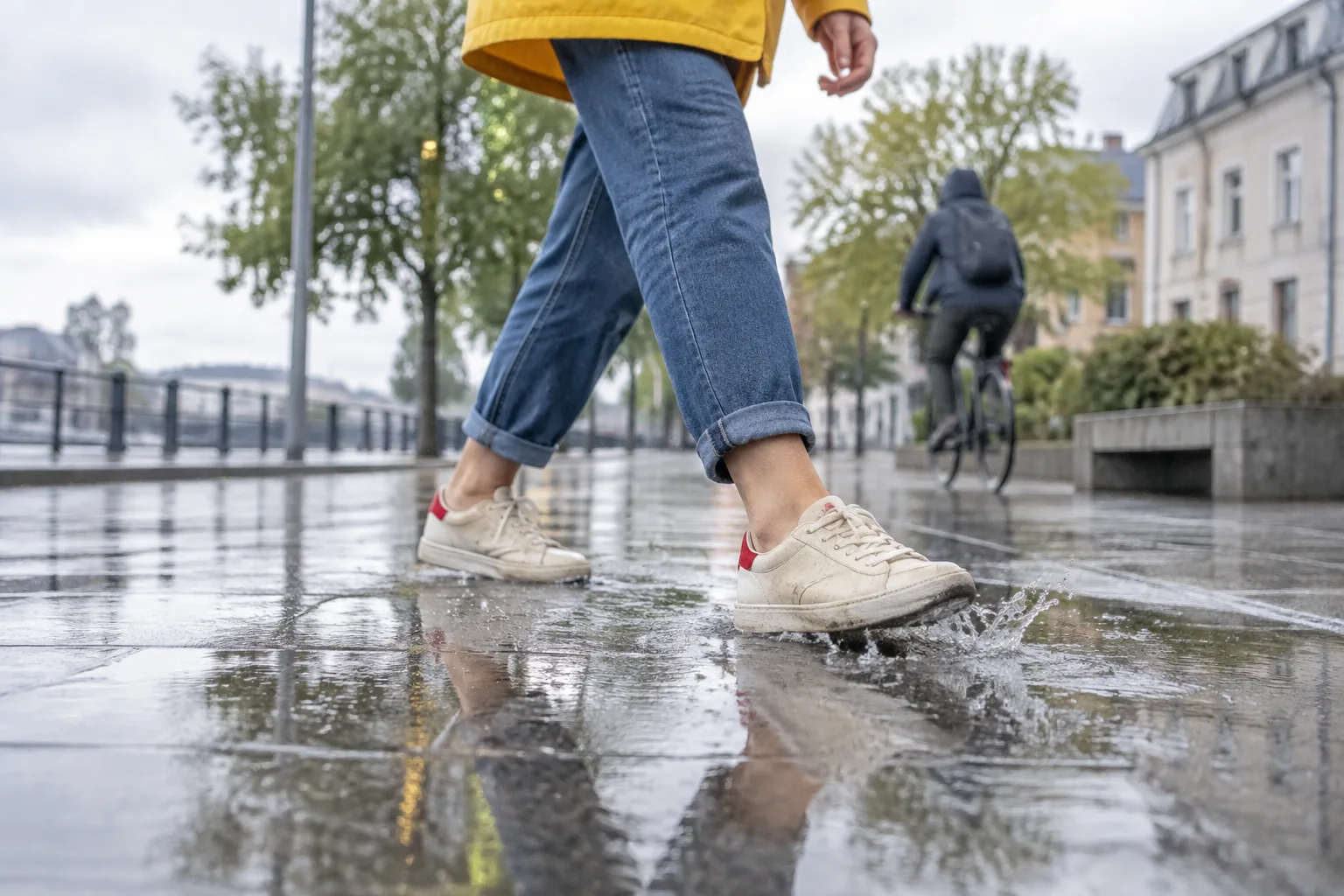
A weather-agnostic sneaker handles four conditions without excelling at any one: light rain, wet pavement, cold air, and the warm, humid stretch that follows a shower. It does not need to survive a monsoon. It needs to survive the twenty minutes between a train station and an office when the sky cannot decide, and then be wearable again at lunch.
That sets a narrow material brief. The upper has to shed brief moisture without sealing shut. The outsole needs enough tread to grip painted crosswalk lines and wet stone, which are the two surfaces that actually cause slips in cities. The midsole has to keep some rebound when temperatures drop into the forties. And the whole thing has to breathe well enough that a person does not arrive at a desk with damp socks on a mild day.
Very few shoes are marketed this way. Most waterproof sneakers are sold as all-or-nothing, and most breathable sneakers are sold as summer shoes. The in-between category exists, but it is assembled from parts rather than advertised as a whole.
The Upper: Tight Weave, DWR, and No Membrane
The single most useful upgrade for in-between weather is a densely woven synthetic upper treated with a durable water repellent finish. The weave itself slows water penetration, and the DWR makes light rain bead and roll instead of soaking in. Neither is waterproof. Together they handle drizzle, wet grass, and the splash from a passing bus, and they keep breathing because there is no membrane blocking vapor.
A shoe like the Nike Air Zoom Pegasus Shield follows this logic: a water-repellent upper, a slightly higher collar, and a full outsole, without a boot-like shell. The trade-off is honest. Step in a deep puddle and the foot gets wet. Stand in steady rain for half an hour and the DWR gives up. For the commute, the dog walk, the errand, that is a fair trade, and the shoe remains comfortable in dry weather, which is the whole point.
Membranes earn their place in genuine storms and in jobs that involve standing outdoors. For everyone else they add heat, stiffness, and cost. A person who owns one pair of waterproof sneakers and wears them from October to April is carrying a furnace on each foot for six months to be ready for four bad afternoons.
Grip Is the Spec Nobody Advertises
Wet-weather falls happen on smooth, painted, or polished surfaces, and the outsole compound matters more than the lug pattern. A soft rubber with a high silica content grips wet pavement better than a hard carbon rubber with deep lugs. The problem is that soft rubber wears quickly on dry concrete, so the in-between shoe needs a compound that is soft enough to hold on wet tile and durable enough to survive a year of sidewalks.
This is where the trail-running shelf beats the lifestyle shelf. Shoes built for wet rock and root have already solved the compound problem, and several of them cross over into daily wear without looking like hiking boots. The Salomon Sense Ride and the Hoka Speedgoat both use sticky rubber that holds on wet asphalt, and both have a rock plate or protective layer underfoot that keeps sharp pavement from bruising the sole of the foot on long walks. The Speedgoat's stack height is an acquired taste for city wear, but the grip is not in question.
The lug depth worth aiming for sits around three to four millimeters: enough to bite into wet grass and loose gravel, shallow enough that the shoe does not feel like it is walking on cleats when the ground is dry. Deep, aggressive lugs are a liability on smooth wet concrete because the contact patch shrinks.
Foam That Does Not Freeze
EVA foam stiffens as the temperature falls, and a midsole that feels plush at seventy degrees can feel like a plank at forty. The fix is a foam with a wider working temperature range, and the supercritical foams that entered running shoes over the past several years happen to fit. They retain rebound in cold air better than standard EVA, and they are lighter, which matters when the shoe is also carrying a heavier upper.
The New Balance Fresh Foam X More and the Adidas Ultraboost Light both use foams that stay usable in chilly conditions, and both come in colorways that do not scream performance. The Ultraboost in particular has a knit upper that is denser than it looks, sheds a light shower reasonably well, and remains one of the more comfortable shoes for a full day on foot. It is not a rain shoe. It is a shoe that does not fall apart when the weather turns.
A midsole also needs a little structure for wet conditions. A soft, unstable foam on a wet surface encourages the ankle to roll, and the in-between shoe should sit closer to the firm end of the spectrum than the marshmallow end. Cushioning matters, but so does the ability to feel the ground when it is slick.
The Lacing and Collar Details That Keep Water Out
Water enters a shoe through the collar and the tongue long before it penetrates the upper. A gusseted tongue, one that is attached to the upper along its sides rather than floating free, closes the biggest gap. A slightly higher collar with a soft, close fit keeps splash and runoff from running down the ankle. Neither feature adds weight or heat, and both are common on trail and shield models.
Laces deserve a mention because wet laces loosen. A flat lace with a textured surface holds a knot better than a round, slick one, and a lace that stays tied in the rain is a small but real comfort. Some shield models use a quick-pull system, which is convenient but can slip when wet; a standard flat lace tied with a double knot is the more reliable choice.
Three Pairs That Cover the Middle
The Pegasus Shield is the everyday commuter: water-repellent upper, reliable outsole, a fit that suits most feet, and a price that does not sting. It handles drizzle and wet pavement and stays wearable in dry weather. The main limitation is the DWR, which wears off after a season of regular use and can be restored with a spray treatment.
The Salomon Sense Ride is the grip specialist. Sticky rubber, a protective layer underfoot, and a fit that locks the foot down make it the choice for anyone who walks on wet stone, painted lines, or uneven ground. It looks like a trail shoe, because it is one, and that is a fair trade for the confidence it provides on slick surfaces.
The Ultraboost Light is the comfort option for cold, damp days when the priority is warmth and cushioning rather than technical performance. The denser knit sheds light rain, the foam stays usable in the cold, and the shoe is pleasant for long stretches on foot. It is the least weather-ready of the three and the most comfortable in cool, dry air.
None of these shoes is waterproof, and that is the point. A person who wants to stay dry in a storm should own a boot or a fully sealed shoe and accept the heat. A person who wants one pair to handle the ordinary, undecided weather of most days should own something in the middle, and the middle is a better place to live than either extreme.
Rotating Two Pairs Beats Owning One Perfect Pair
The most practical weather strategy is not a single do-everything shoe but a two-pair rotation: one water-repellent, breathable pair for the ordinary damp day, and one fully waterproof pair for the genuine storm. The first pair does most of the work, stays comfortable, and wears out slowly because it is not being asked to do the impossible. The second pair sits by the door for the days that justify it.
The rotation also solves the drying problem. A shoe that gets damp needs a full day to dry, and a person with only one pair puts them back on wet the next morning, which accelerates the breakdown of the foam and the lining. Two pairs alternate, dry fully, and last longer than either would alone. The cost of the second pair is partly offset by the extended life of the first.
The in-between shoe is not a compromise. It is the shoe that gets worn most often, and it deserves to be chosen on purpose rather than settled for. The weather will keep being undecided. The footwear can be decided in advance.