

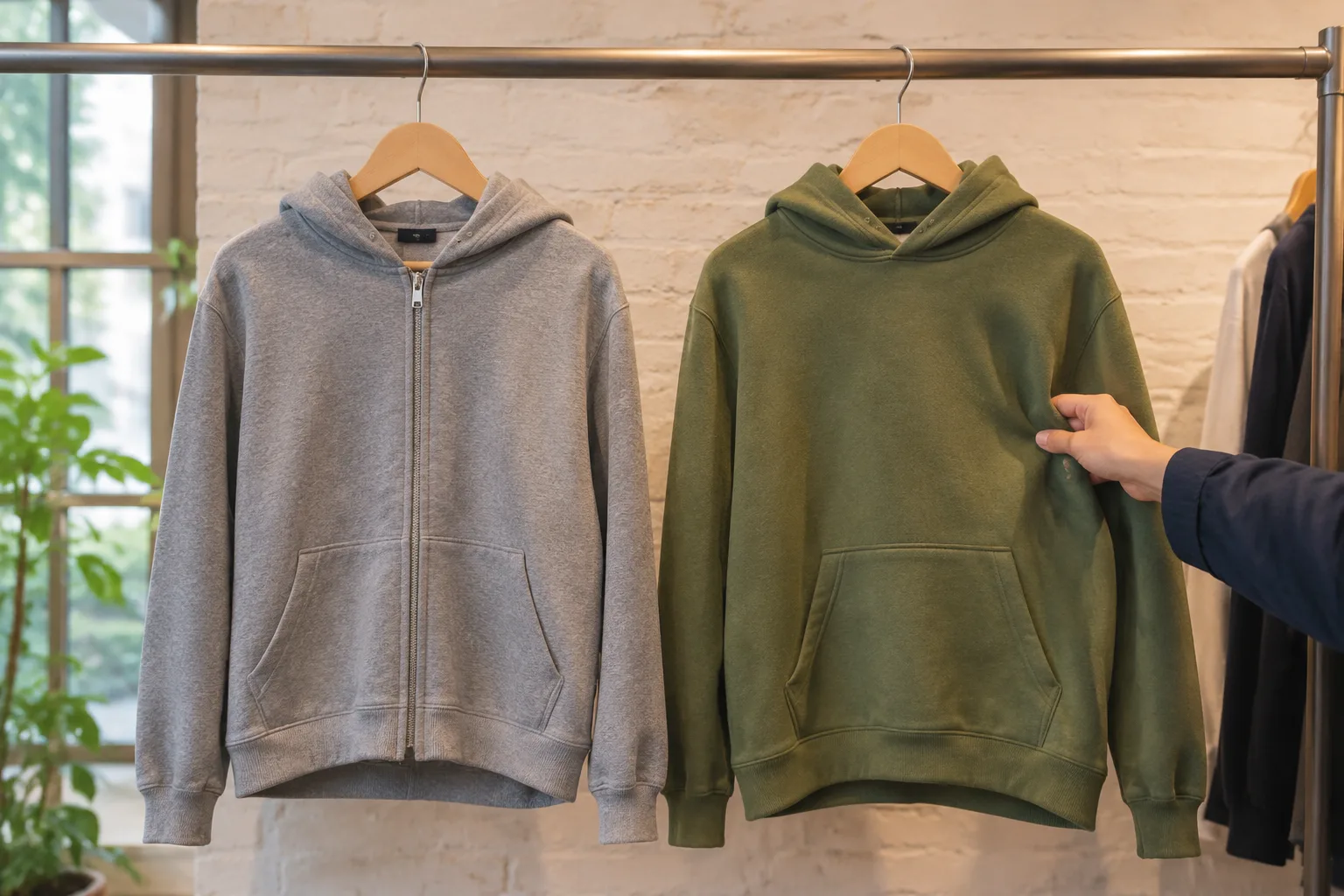
Zip or Pullover: Two Hoodies, Two Very Different Outfits
The zipper runs from hem to chin on a hoodie hanging in a shop doorway, teeth closed, pull resting at the collar. Ten feet away, a pullover hangs on the same rack with nothing to open and nothing to adjust. Same fabric weight, roughly the same price, same rack. The two garments get treated as interchangeable by most shoppers, and that assumption costs people outfits they could have worn well and hands them outfits they will never quite pull off.
The gap between these two hoodies is bigger than a strip of metal. One is a jacket that happens to be soft. The other is a shirt that happens to have a hood. Build an outfit around the wrong one and the whole thing fights itself, no matter how good the individual pieces are.
What a zipper actually does to a silhouette
A full-zip hoodie splits down the middle. That vertical line does real work: it narrows the torso, gives the eye somewhere to travel, and creates two front panels that can hang slightly apart from the body. On a lean frame, that split reads as structure. On a heavier frame, an open zip creates two vertical edges that frame the chest instead of one solid block of fabric wrapping it.
A pullover has no such line. The fabric crosses the chest in one unbroken plane, which means the shape of the garment is the shape of the wearer, plus whatever the hood and kangaroo pocket add. A pullover on a rounder torso can look like a sack with sleeves. A pullover on a narrow torso can look like a tent. The fix is fit, and fit is the only tool a pullover offers.
That asymmetry in how the two garments flatter is the first reason they belong in different outfits. The zip gives a person control over how much of that vertical line shows. The pullover gives none.
The zip as a temperature dial
Anyone who has worn a hoodie through a full day knows the problem: mornings are cold, the office is warm, the walk home is cold again. A zip handles that with a pull tab. Open it at the chest and the body vents. Close it and the warmth comes back. The garment becomes a thermostat a person carries.
A pullover handles the same problem by being taken off entirely, which means it has to be carried, stuffed in a bag, or tied around the waist. Tied around the waist, it becomes part of the outfit whether the wearer planned for that or not. The sleeves knot in front, the body swings behind, and the whole look shifts toward something looser and more casual. That can be a good move. It is never a neutral one.
Layering is where the difference compounds. A zip hoodie works as a mid layer under a coat because it can be opened without removing the coat. A pullover under a coat traps heat against the chest and has to come off over the head, which means the coat comes off first. In a cold climate, that sequence matters several times a day.
Why the pullover reads smarter in some rooms
There is a reason tech founders, architects, and a certain kind of creative director reach for the pullover. The absence of hardware makes it quieter. No zipper pull catching the light, no metal teeth at the throat, no split at the hem. The garment reads as one piece of fabric, and one piece of fabric reads as considered.
Pair a heather grey pullover with wool trousers and leather sneakers and the outfit lands somewhere between weekend and studio. Pair the same trousers with a zip hoodie and the metal at the chest pulls the eye and adds a sporty edge that fights the tailoring. The zip wants to be casual. The pullover is willing to be almost anything.
That flexibility has a ceiling. A pullover will never look sharp in the way a collared shirt does, and it will never look technical in the way a zip can. What it does is hold a middle register: relaxed, intentional, slightly underdressed on purpose. For a dinner that is not quite formal, a pullover in a dark color with clean trousers gets closer than a zip ever will.
The zip's home turf: movement and utility
Where the zip wins without argument is anywhere the body is in motion. A run, a bike commute, a gym warm-up, a hike that starts cold and ends sweaty. The ability to open the chest without stopping is the whole point. Pullovers in those settings become a nuisance the moment the body heats up.
The zip also carries pockets better. A full-zip hoodie usually has two hand pockets set into the front panels, sometimes with zips of their own, and those pockets sit at hip height where hands naturally fall. A pullover's kangaroo pocket sits higher and wider, which is great for warming hands and terrible for carrying anything with weight. Keys in a kangaroo pocket swing against the stomach with every step. Keys in a zip pocket stay put.
The hardware itself is part of the appeal. A metal zipper with some weight to it, a pull tab that feels solid between two fingers, the small ritual of zipping up against a cold wind: these details give the zip hoodie a tool-like quality that the pullover cannot match. It is a garment with a mechanism, and mechanisms invite use.
Fit rules that differ between the two
Zip hoodies tolerate a looser fit than pullovers do. Because the front can open, excess fabric at the chest and waist reads as drape rather than bulk. A zip that is slightly oversized looks relaxed. A pullover that is slightly oversized looks like a mistake, unless the wearer commits fully to the oversized look with dropped shoulders and a longer body, in which case it becomes a deliberate silhouette.
The halfway oversized pullover, the one that is a size too big but not two, is the worst of both worlds. It bunches at the waist, the shoulders slump past the natural seam, and the hood collapses backward. The fix is to size down or size up but never to sit in the middle. Zip hoodies are more forgiving of that middle ground, which makes them the safer purchase for anyone buying without trying the garment on.
Hood shape matters too, and it differs by closure. A pullover's hood has to be large enough to clear the head without a zip, which means it often sits fuller and higher at the back of the neck. A zip's hood can be trimmed closer because the neck opening adjusts. On a shorter neck, the fuller pullover hood can swallow the chin. On a longer neck, the trimmed zip hood can look undersized. Neither is better; they suit different bodies.
The outfit each one builds around itself
Start with the pullover. Dark navy or charcoal, mid weight, clean hem. Under it, a plain white tee with the collar just visible at the neck. On the bottom, straight-leg denim in a dark wash or wool trousers in grey. On the feet, leather sneakers or a Derby shoe. The result is a quiet outfit with one soft piece and several structured ones. The pullover softens the tailoring without undercutting it.
Now the zip. Heather grey or black, slightly oversized, metal zipper. Worn open over a plain tee, with tapered joggers or slim jeans and chunky sneakers. The open front shows the shirt underneath, the vertical line narrows the torso, and the whole thing reads as athletic without trying. Close the zip and the same outfit becomes colder and more contained. Swap the joggers for cargo trousers and the look goes workwear. The zip is a switch.
The mistake is mixing the registers. A pullover styled with joggers and running shoes looks like gym clothes that gave up. A zip hoodie styled with wool trousers and a Derby looks like a suit that called in sick. Each garment has a natural range, and the outfit works when the surrounding pieces stay inside it.
When the hardware becomes the problem
Zippers fail. Teeth skip, sliders jam, the tape pulls away from the fabric at the bottom stop. A zip hoodie that will not close is a hoodie with a permanent vent, and the repair is either a tailor or a replacement. Pullovers have no such failure point. The seams hold or they do not, and a pullover with a blown seam is unusual in a way a broken zipper is not.
There is a sensory cost too. Metal teeth against the throat on a cold morning, the pull tab tapping against the chest during a walk, the slight stiffness where the zip meets the collar. Most wearers stop noticing after a few minutes. Some never do, and for them the pullover's uninterrupted softness at the neck is worth more than every advantage the zip offers.
Weight tells a similar story. A quality metal zip adds real grams to the front of the garment, which pulls the hoodie forward at the shoulders and can make the collar sit unevenly. A pullover distributes its weight evenly because there is nothing to distribute around. On a long wear, that difference shows up in how the garment sits at the end of the day.
The case for owning one of each
Two hoodies, two jobs. The zip is the one that goes on a bike, into a cold morning, under a jacket, and through a day with shifting temperatures. The pullover is the one that goes to a casual dinner, on a flight, into a studio, and over a collared shirt when the dress code is unclear.
Buying only one means choosing a side, and the side is determined by which failure is easier to live with. A pullover that cannot vent is uncomfortable for an hour on a warm afternoon. A zip that cannot be worn quietly is uncomfortable in every room where the outfit needs to be understated. The first problem is physical and temporary. The second is social and constant.
That asymmetry is the practical answer for anyone building a wardrobe from scratch. The pullover is the safer single purchase because it fails less often in the situations that matter, and the zip is the better second purchase because it unlocks the situations the pullover cannot handle. Two hoodies, one closet, and a clear rule about which one leaves the house on which morning.